

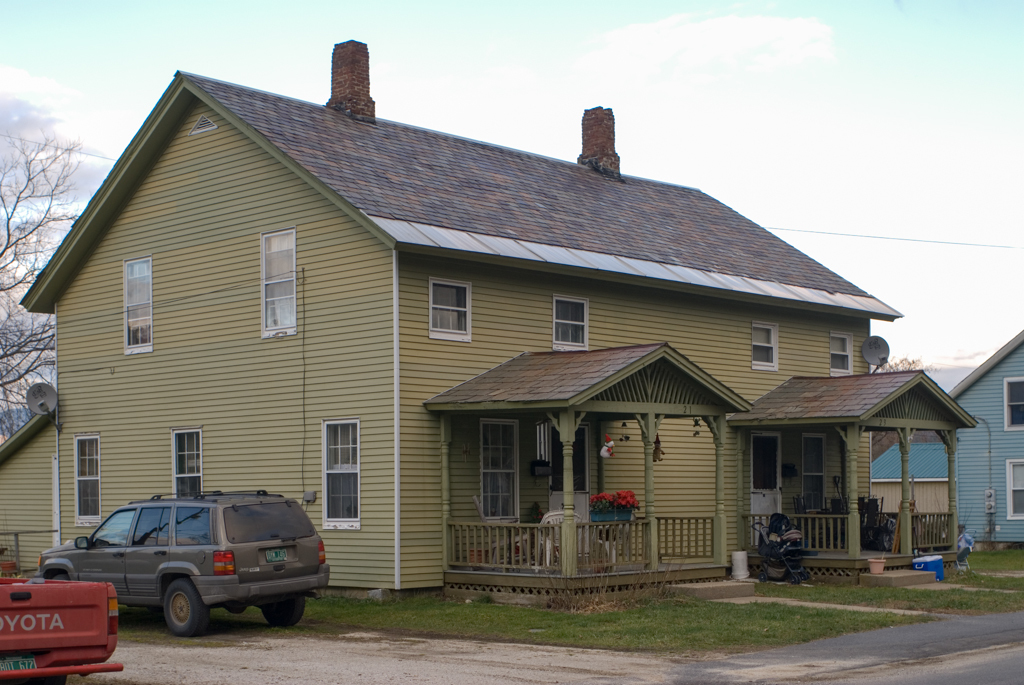
The confluence of late-nineteenth-century Scandinavian immigration, workers' housing traditions, and local industrial labor history produced “Huss-raa,” a street of gabled, two-story duplexes in Proctor village, the marble capital of Vermont. Swedish immigrants gave the name to this “house row,” particularly the striking north side of Meadow Street with ten duplexes in a row. With long eaves sides facing the road, each duplex has a pair of entrance porches that, with different decorative support columns and alternating hipped, gabled, and shed roofs, dress up what otherwise is a basic duplex type popular for workers' housing since the 1830s. The Vermont Marble Company built these units to support its social practice of recruiting new immigrant labor and locating ethnic groups together in company housing. The north end of Proctor village across the railroad tracks, including “Huss-raa,” became the Swedish neighbor hood for families who came to work in the company's quarries and mill.
“Huss-raa”
c. 1891. Both sides of Meadow St., Proctor village