

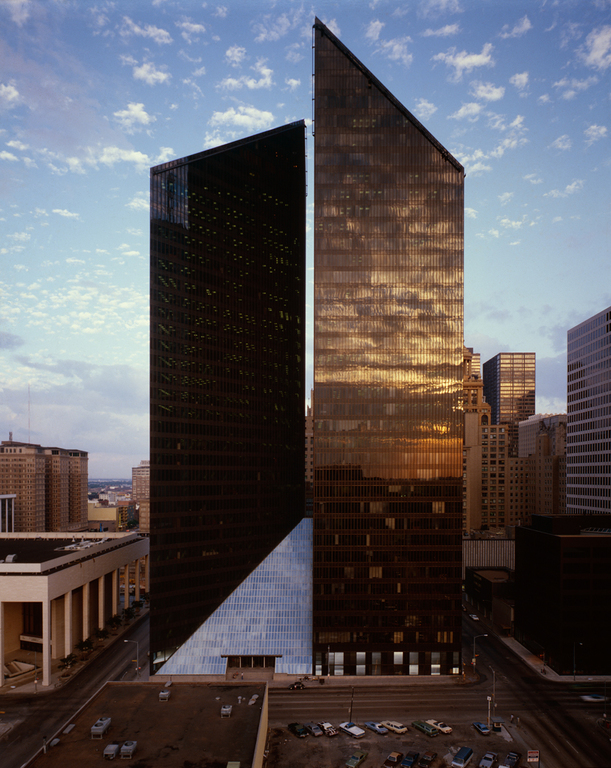
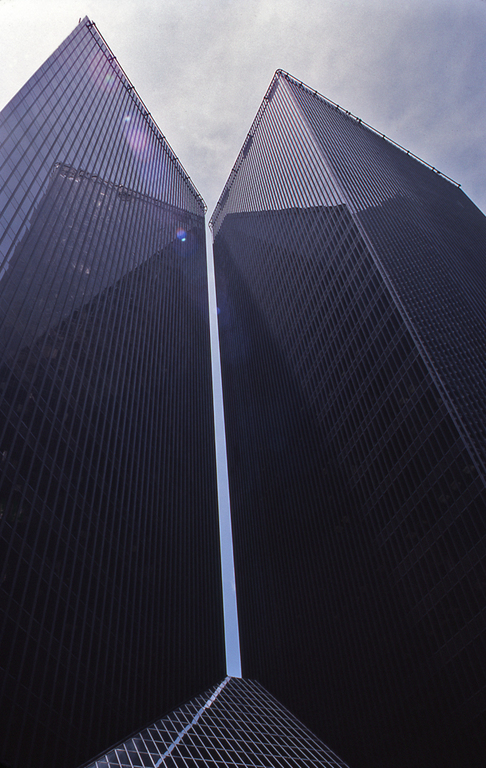
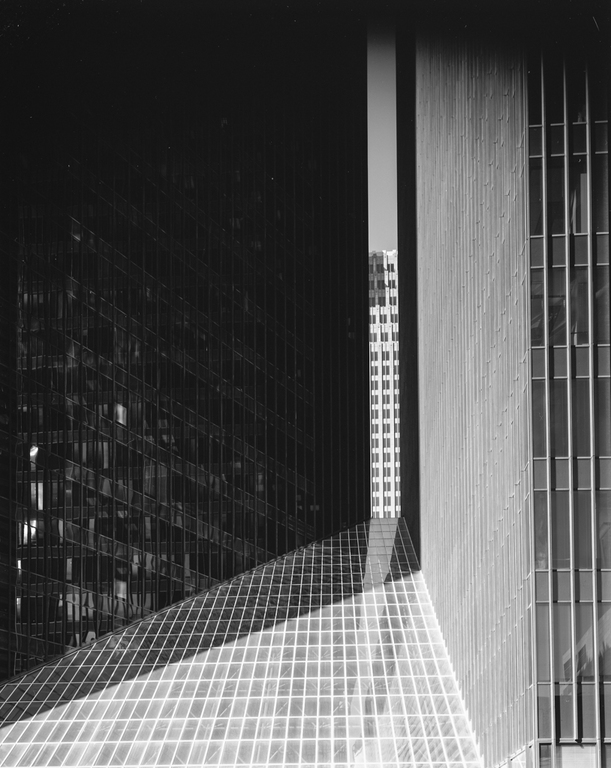
Philip Johnson and John Burgee's pair of thirty-six-story towers, containing 1.8 million square feet of space, with their diagonal geometry, reflective symmetry, and dark glass and aluminum curtain walls, “broke out of the box” (as Johnson phrased it, borrowing a line from Frank Lloyd Wright) of engineering efficiency represented by One Shell Plaza (
HN7). Gerald D. Hines Interests built Pennzoil Place as headquarters for two oil companies, Pennzoil and its onetime affiliate the Zapata Corporation. Johnson and Burgee applied the formal explorations of such American minimalist sculptors as Robert Morris to high-rise architecture. Hines discovered that Pennzoil's formal singularity was more profitable than the monumental efficiencies of One Shell Plaza. In Pennzoil's wake Hines and other Houston developers pressed their architects to design formally extroverted tall buildings. The architectural consequences of Pennzoil's evolutionary breakthrough are visible across the street at 700 Louisiana in the Postmodern fifty-six-story, 1.52-million-square-foot Bank of America Center (RepublicBank Center) of 1983 by Johnson/Burgee Architects and Kendall/Heaton Associates. Pennzoil represents what was most promising about an epoch in Houston's commercial history when energy encompassed not only oil and gas but civic imagination as well.
Pennzoil Place
1976, Johnson/Burgee Architects and S. I. Morris Associates. 711 Louisiana St.