

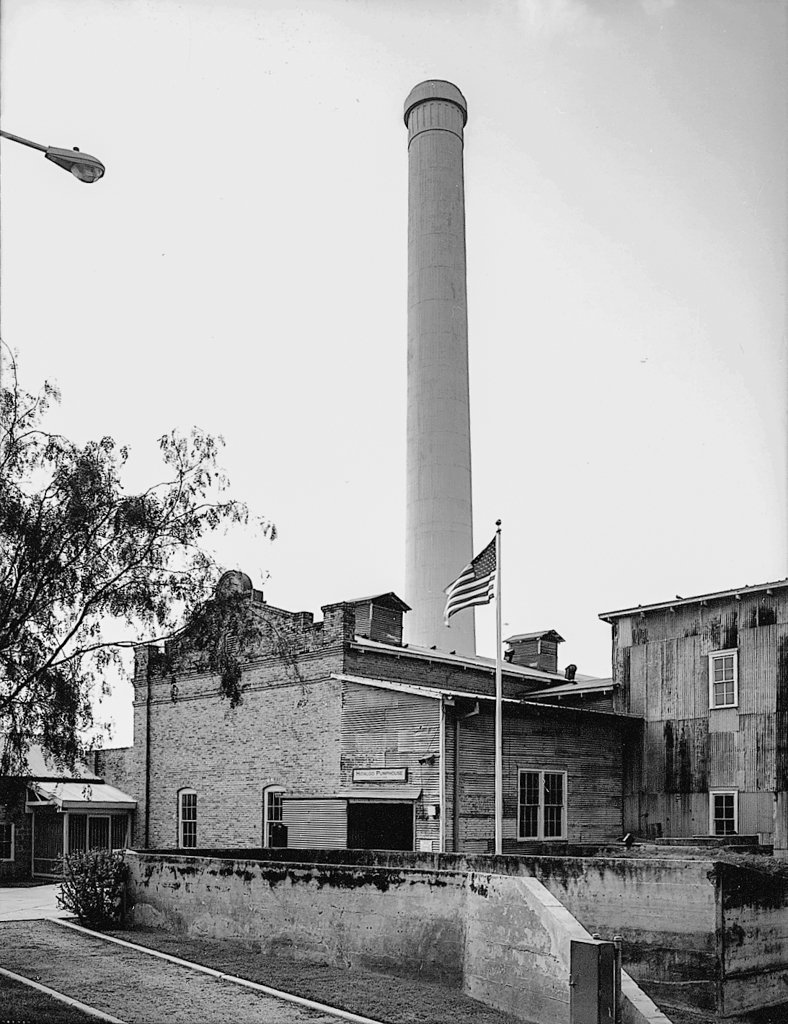
The pumphouse is a vestige of the heyday when entrepreneurs transformed the river delta into one vast agricultural field mechanically irrigated by a network of pumping facilities. This is the last one to remain at the river, and its historic machinery and architectural integrity are nearly intact. Its relationship to the river changed as a result of a flood in 1933 that moved the Rio Grande farther away, necessitating the construction of a one-half-mile-long intake channel.
The pumping station is an ensemble of structures linked together over several decades as new engines, pumps, and boilers were installed to meet increased demand for water and for newer technology. The construction materials include brick, wood, concrete block, and corrugated sheet metal. The buff brick north facade is the only stylistic architectural feature in the entire complex. Framed by raised brick pilasters that engage a projecting cornice, the elevation is topped by a Mission Revival parapet. Not far behind, a one-hundred-foot-tall concrete smokestack punctures the roof, acting as a beacon for the Hidalgo community.
In the interior, the navelike space, covered by an open wood truss system, is so vast that an interpretive center, a building within the building, was installed as part of the 1999 rehabilitation. In the pump room, a twenty-two-foot drop creates a sunken linear space for the giant snail-shaped centrifugal pumps. As the river water flowed through the pumps, it emerged into Lateral A, the main irrigation canal connected to 185 miles of lesser canals that irrigated more than forty-five thousand acres of land.
Collectively, the pumphouse, its canal system with associated standpipes and gates, plus the cultivated farmlands form a cultural landscape that remains today much as originally designed in the first half of the twentieth century. It is difficult to overestimate the social, economic, cultural, and environmental impacts involved in the creation of this landscape, in which the pumphouse played a major role. Native vegetation was uprooted to create farmlands, and a traditional ranching economy gave way to an agriculture-based economy, bringing with it rapid urban development and a midwestern Anglo-American population with a new set of cultural attitudes. Decommissioned in 1983, the pump-house currently serves as an agricultural museum, while the river waters are pumped to those same historic canals by an electric facility one-half-mile downriver.