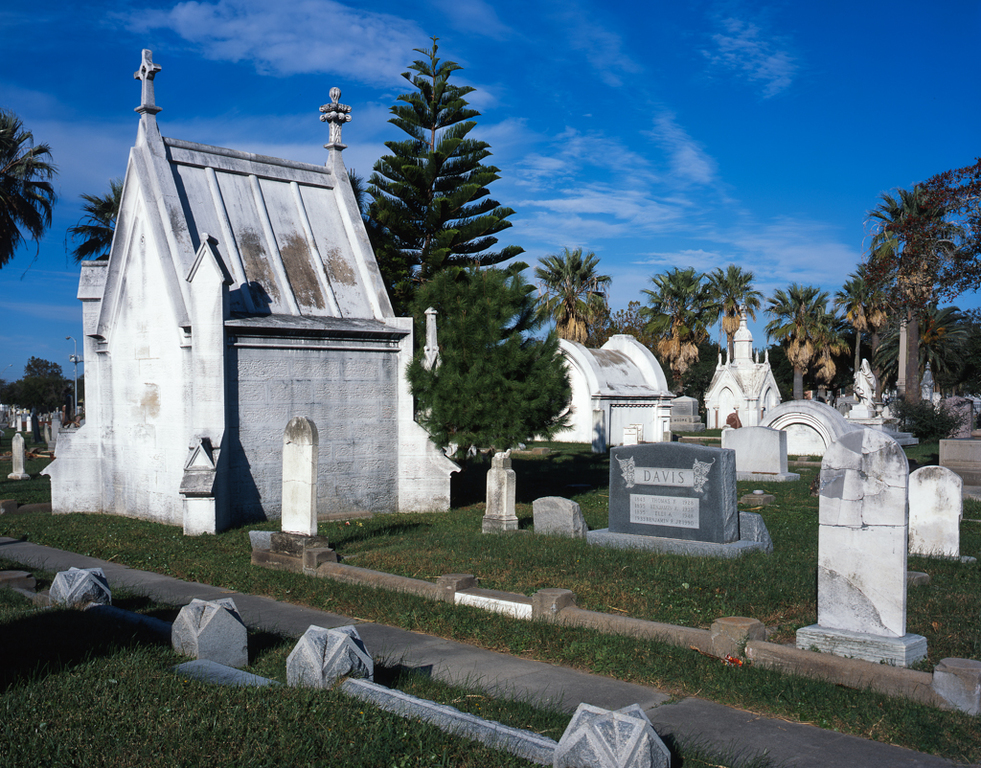
This vault, built of stuccoed block, is one of the many professionally designed monuments erected in the six-block collection of cemeteries set aside for burials by the Galveston City Company in 1840–1841. The City Company apportioned cemeteries to different religious and nonreligious groups, so the six blocks are subdivided into a series of cemeteries bisected by Avenue K and partitioned with low fences. All employ the same pattern of spatial organization: a gridded network of narrow walks (now paved) with minimal vegetation. As on Strand and Broadway, there was a not-so-discreet competition, even in death, for architectural singularity among Galveston's elite. Episcopal Cemetery, where the Willis Vault is located, has an especially fine collection of late-nineteenth-century monuments. Short Willis's uncle, P. J. Willis, rests in a Gothic Revival vault with a cupola. P. J. Willis's daughter, Magnolia Willis Sealy, had the last word in terms of style, commissioning McKim, Mead and White to design the George Sealy monument for her husband in 1903. It is a work of awesome understatement: a polished pink granite slab capped by acroteria and decorated with a bronze garland.

