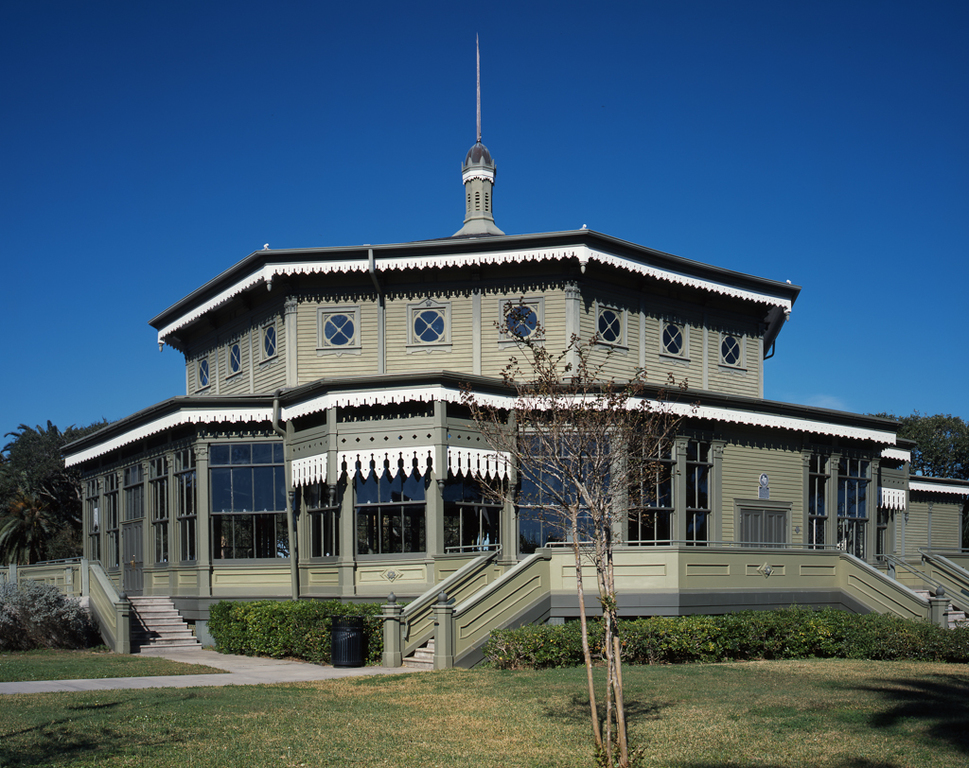
The Garten Verein was the late-nineteenth-century version of a country club. It was a pleasure garden, built on what had been the suburban estate of Robert Mills, commission merchant, banker, and sugar planter who had been the largest slaveholder in Texas. Mills's bankruptcy during the Panic of 1873 precipitated the sale of his property, the east half of an outlot, to the Galveston Garten Verein, Galveston's elite German social club. The Garten Verein built this octagonal wood pavilion as its dancing pavilion. Internally, the two-tiered building is open and spacious. Although construction of the dance pavilion was reported in the Galveston Daily News, no architect was ever identified. The building was severely damaged in the Storm of 1900 but reconstructed. In the aftermath of World War I, the Garten Verein dissolved and its property was acquired by Stanley Kempner, who gave the five-acre site to the City of Galveston as a park in honor of his mother, Eliza Seinsheimer Kempner, and in memory of his father, H. Kempner. The dancing pavilion is the only club building remaining on the site. In 1981, it was restored by San Antonio architects Joe Stubblefield and Michael Hilger. At that time, it was repainted in dark, full-bodied colors.

