

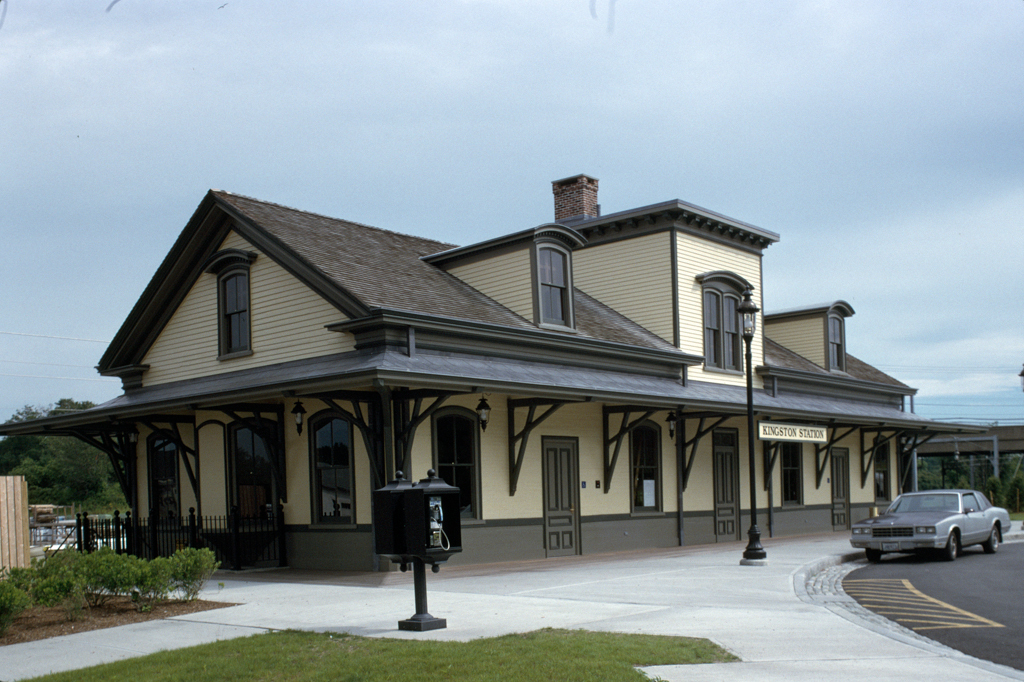
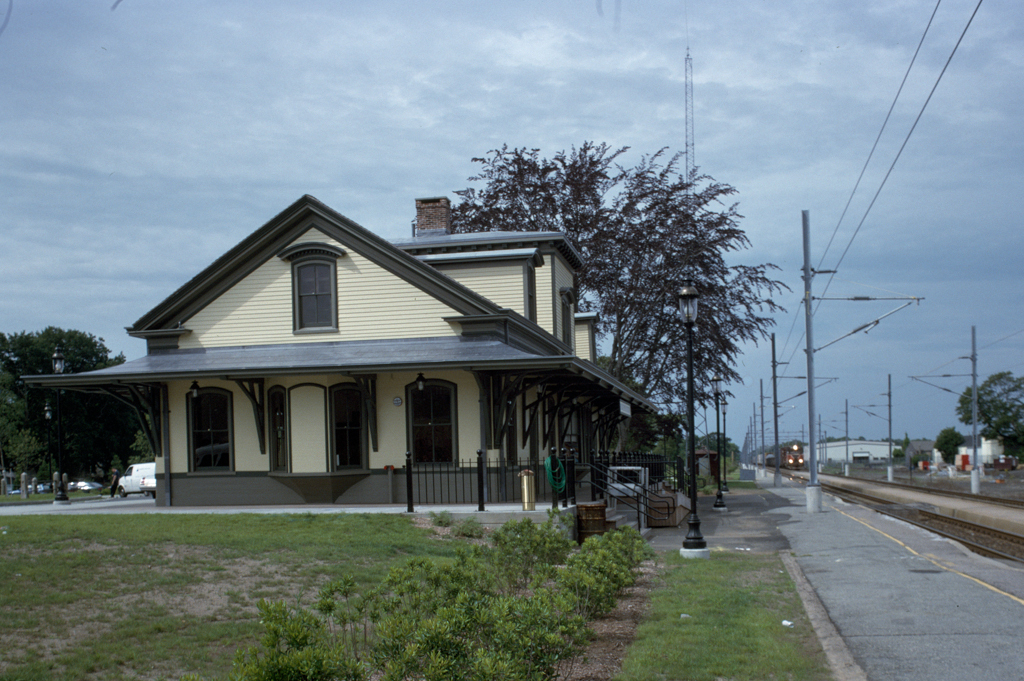
Despite its location, this has always been known locally as Kingston Station. But then, it was really meant for Kingston. It is the only station built by the New York, Providence and Boston Railroad still in use. That this building in the late nineteenth-century Stick Style should have continued in use as an express stop on the main New York–Boston line is extraordinary. And that it and the Peace Dale Station exist in such close proximity is especially so. The station at Peace Dale is more fanciful, more exceptional. Kingston is comfortably run-of-the-line for its period. It is a straightforward bracketed and gabled building, clapboarded and flushboarded, with the typical swell of the ticket seller's bay window between doors giving onto a platform with a gabled canopy. The station itself supports one side of the canopy; posts with diagonal bracing support the track side. The canopy slides beyond the station in both directions in a nice bit of expressive functionalism: instead of the stodgy solution of two bracketed posts to terminate the canopy, the theme of the single row of posts retains its consistency with the move of the terminating supports to a position directly under the gable. This also reinforces the umbrellalike lightness of the canopy. A boxy mini-tower between dormers on the roof provides minimal living
Kingston Railroad Station
1875. Restoration, 1960. 1988, partially burned. 1989–1990, re-restored. 1 Railroad Ave.