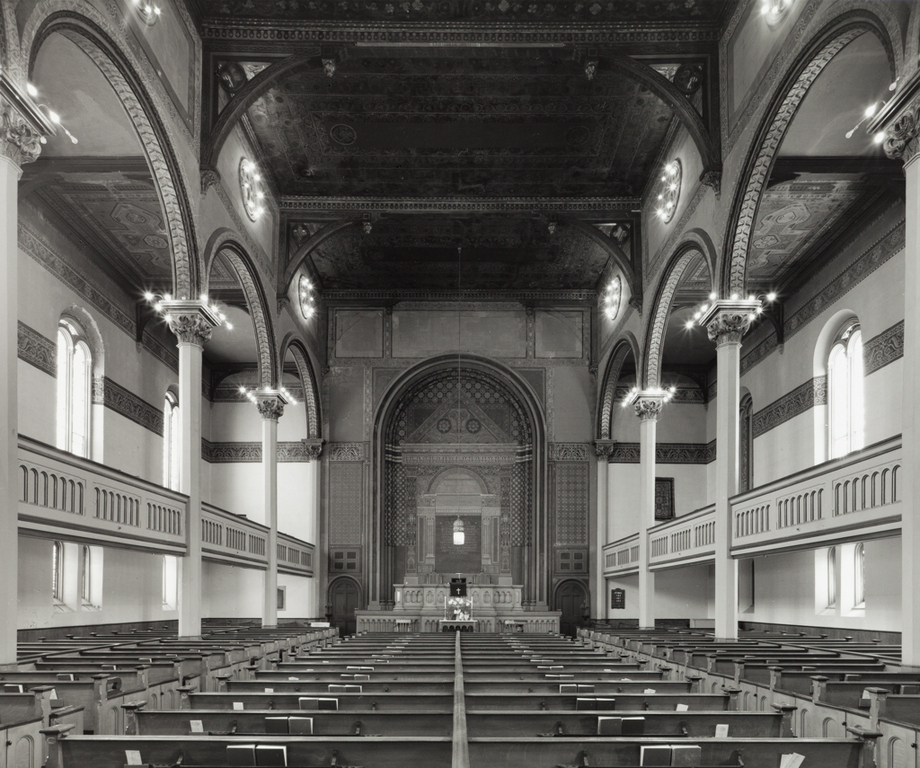
This church in random masonry, compellingly stern, is a cardinal example of the so-called Lombard Romanesque or, more generally, round-arched, style recommended by the Congregational Church in a publication of 1853 as a type suitably churchly in appearance, but appropriately simpler than the Gothic favored by Episcopalians. Its vast, shadowy, balconied interior is equally severe but animated by La Farge's intricate color patterns, inspired by abstract patterning from Oriental carpets, which are centered in a painted tabernacle behind the pulpit, and a Tiffany lantern above. Decorative panels across the gabled ceiling directly suggest rugs suspended tentlike over the space. Beautiful stained glass in abstract designs completes the decorative ensemble. A strange conjunction—exoticism and Congregationalism. La Farge came to Newport directly from his decoration of the interior of H. H. Richardson's Trinity Church in Boston. There the decoration is better integrated with the architecture; here it seems to float in the raw space with too little architectural detail to cling to, living a somewhat disembodied life of its own. Both commissions were important harbingers for the popularity of murals and the collaboration of artists with architects at the end of the nineteenth century as part of the American Renaissance. As for Wells, he ended his professional career as a top designer in the office of McKim, Mead and White, where, in the 1880s, he, more than anyone, showed the senior partners the way to the Renaissance forms which accounted for the central role they played in the American movement. So this forceful church is fascinating, not only as an outstanding example of Congregational round-arched style, but as a herald of a future not yet formulated.


 John M. Miller