

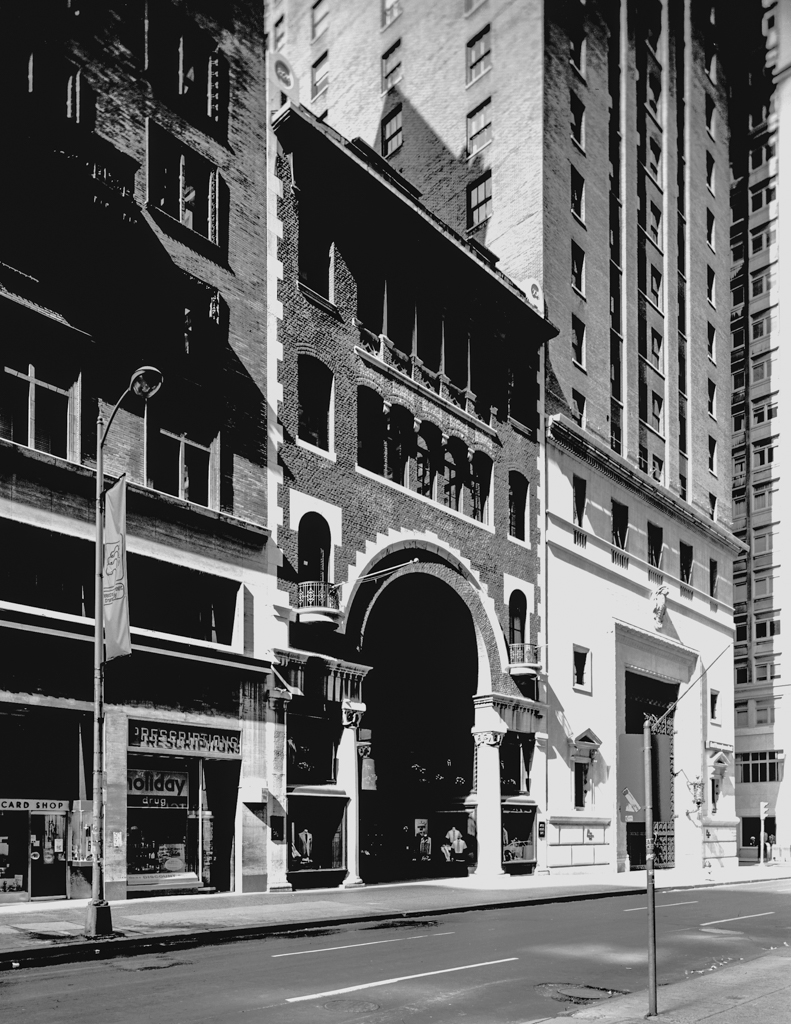
Taking a cue from his teacher Frank Furness, William L. Price here anticipated pop distortion of scale, adapting a Palladian window as the entire lower storefront facade to the building, with a rich Arts and Crafts tapestry of brick and tile above. It won the approval of one of Price's friends, architect C. R. Ashbee, who contrasted it with the “traditional” work of McKim, Mead and White at the nearby former Girard Trust Company (
PH53). The Palladian arch of the entrance continues in the barrel-vaulted nave of the interior (now a drug store), where the custom-made men's suits for which Reed's store was known were displayed, while the shirts and other necessaries of this men's world were dispensed from cases along the lower side aisles. Electric lights behind the leaded glass windows of the lunettes of the vault give the illusion of a freestanding structure. The upper levels, carried on an early post-and-beam reinforced
CVS Pharmacy (Jacob Reed's Sons Store)
1903–1904, Price and McLanahan. 1424 Chestnut St.