

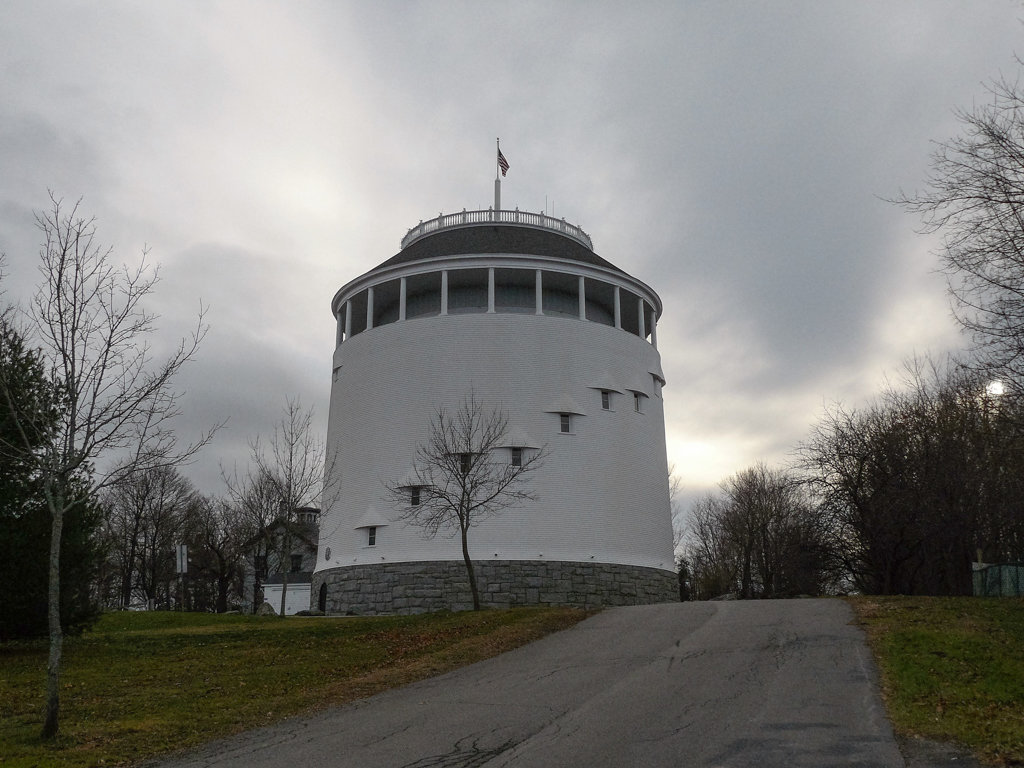
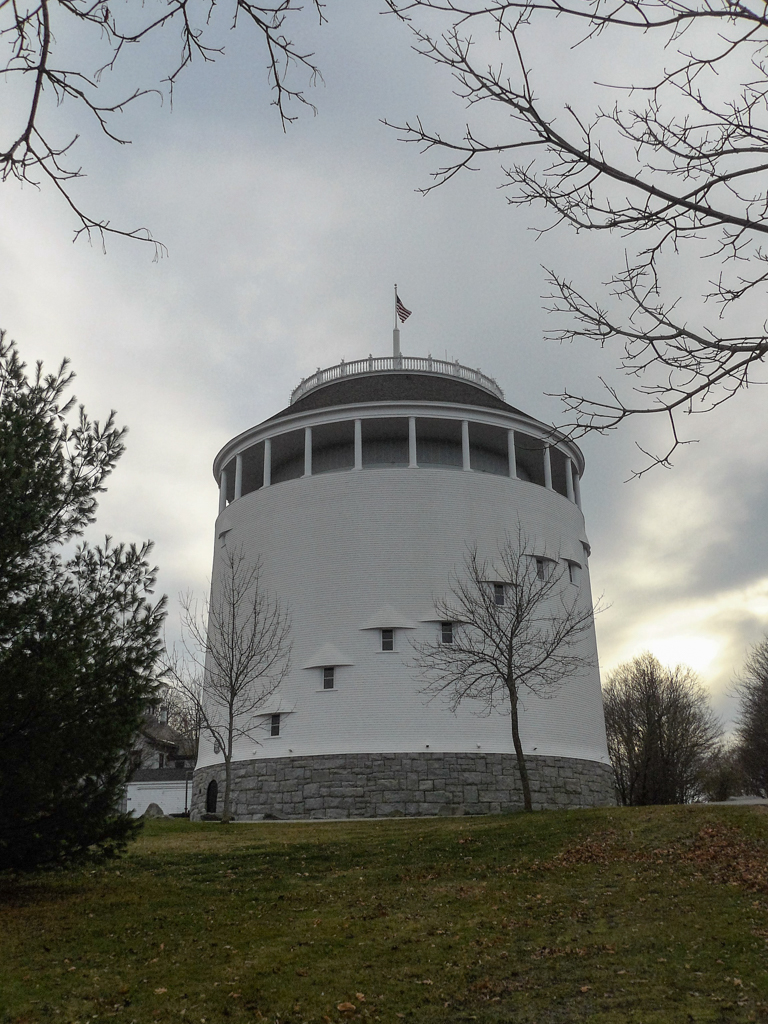
Located on Thomas Hill, close to the Penobscot River, the 1.75 million gallon standpipe rests on the highest point of Bangor. The impressive structure uses gravity to supply water into the city’s pipe system. Built in 1898, the round, Shingle Style water tank is both functional and attractive. It was built in a style made nationally popular by Portland architect John Calvin Stevens. Not only did Bangor turn to Portland for its architectural inspiration, this “Lumber Capital” also, ironically, turned to the city for the lumber to build the standpipe. Bangor contractor Major James M. Davis completed construction in six months using plans and specifications supplied by architect Ashley B. Tower of Tower and Wallace in Holyoke, Massachusetts.
The standpipe is actually two structures: the wooden exterior encloses the riveted, steel-plated interior. The exterior is 80 feet in diameter and 110 feet high, and sits atop a stone foundation 9 feet high and 3.5 feet thick at the base. A 14-foot sill, made of bent pine planks, rests on the foundation. A winding staircase runs along the inner wall of the exterior facade and leads to a 12-foot-wide promenade deck that has a circumference of 280 feet. Along this winding interior staircase are a series of small windows hooded on the exterior. The promenade deck, ceiling, and circular wall concealing the standpipe are all constructed of pine. From the promenade deck a series of stairways lead to the roof, which is surrounded by a railing with 192 four-foot bannisters; inside this railing is a smaller deck 76 feet in diameter. The entire framework of the exterior structure consists of pine posts and spruce studding. The riveted, steel-plated standpipe on the interior measures 75 feet in diameter and 50 feet high.
As is obvious from this description, besides its primary function to store and distribute water, Bangor’s standpipe was designed as an observatory for viewing the river and the city. “The view,” according to a contemporary newspaper, “can give Bangoreans nothing but a feeling of pride at the beauty of our city, every part of which is in plain sight.” The standpipe still stands as a distinctive urban landmark. It is unaltered and well maintained and is open for tours several times a year.