

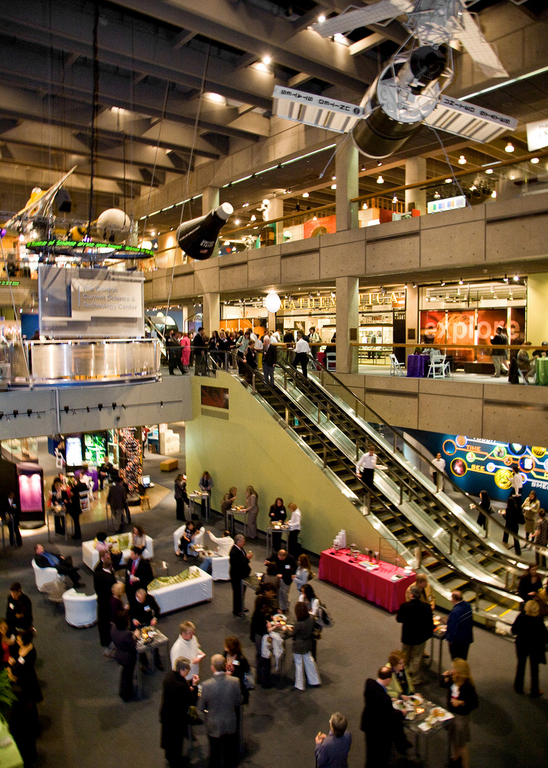
The Museum of Science rests on a site of many layers. Here stood the Craigie Bridge (see EC2; 1807), connecting Boston to Lechmere Point in East Cambridge. The Charles River Dam (1905–1910, Hiram A. Miller, engineer, NRD) replaced the bridge, finally dividing the freshwater Charles River from the saltwater harbor beyond. Guy Lowell designed a park on top of the dam and the upper and lower lock gatehouses, open pavilion, boathouse, and stable that survive. The Museum of Natural History, located since 1862 in a building (now Louis, Boston, BB23) on Berkeley Street between Boylston and Newbury streets, moved to temporary new quarters on the dam in 1949 and began construction of buildings soon thereafter. Over the past half century, a series of red brick, clean, modernist additions, focused on a central tower surmounted by an aluminum steeple and weathervane, have expanded the scale and programs of the renamed Museum of Science. After enjoying the delights of the domed Hayden Planetarium or adjacent Mugar Omni Theater, the museumgoer should seek out the spectacular views of the Charles River Basin (NRD) to the west. In contrast, across from the entrance rises the MBTA Green Line viaduct (1910–1911, Peabody and Stearns, NRD), designed to elevate the subway trains above the requirements for navigation of the river and to provide a screen for the harbor end of the Great Basin.
Museum of Science, Hayden Planetarium, and Mugar Omni Theater
 David Fox
Museum of Science, Hayden Planetarium, and Mugar Omni Theater
1951 east wing, Ames, Child and Graves; 1958 Hayden Planetarium, Ames, Child and Graves; 1961 central wing, Perry, Shaw, Hepburn and Dean; 1968 garage, E. Vernor Johnson, Robert N. Hotvedt and Associates; 1972 west wing, E. Vernor Johnson, Robert N. Hotvedt and Associates; 1987 east wing addition, Stubbins Associates. Science Park, Charles River Dam.