

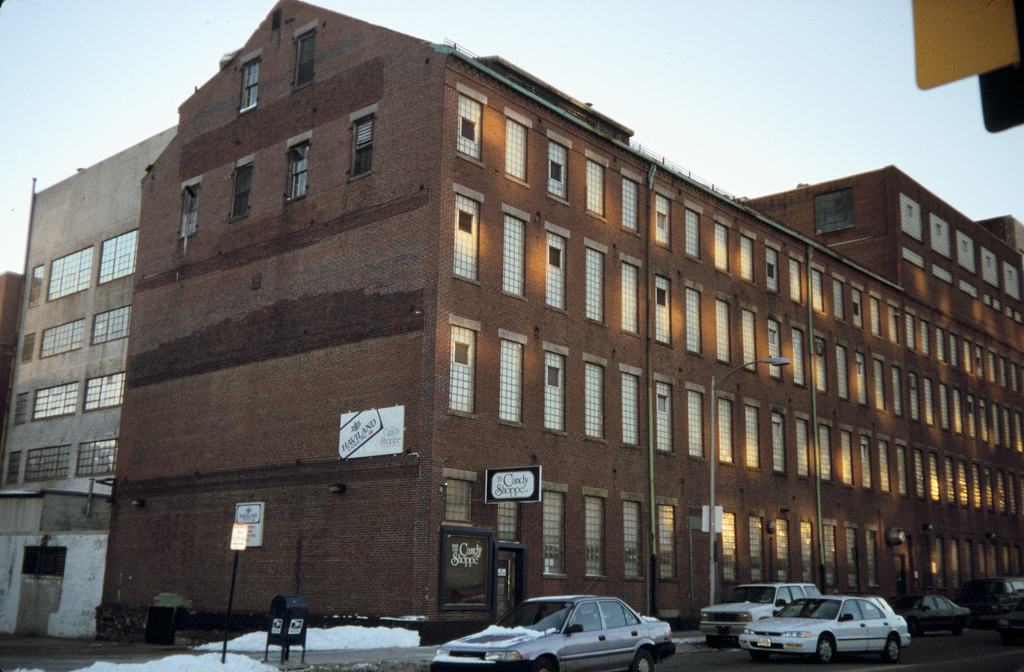
The two blocks bounded by 1st, 2nd, Cambridge, and Thorndike streets and bisected by Otis were the heart of the Cambridge furniture industry for over a century. Ferdinand Geldowsky, who in 1857 started a furniture business in Boston, moved east in 1863 to the corner of Otis and 1st streets in East Cambridge and was followed by many other furniture makers. Among the best known were Charles Irving and Robert Casson, partners from 1874 to 1925, who moved here from Boston in 1885 and by the 1890s had consolidated all the factories south of Otis Street. Irving & Casson was known for its fine cabinetwork, mantels, and interior finish. In 1883, Albert H. Davenport moved his company to
Frequent collaborators, the two companies merged in 1914. The factories north of Otis were sold to confectionery firms in 1936, and numerous postwar additions were made to its remaining plant; the company closed its doors in 1972. The original Irving & Casson site south of Otis was redeveloped in 1986 as the Davenport Building, with the former alleyways between the buildings converted to enclosed atria.