

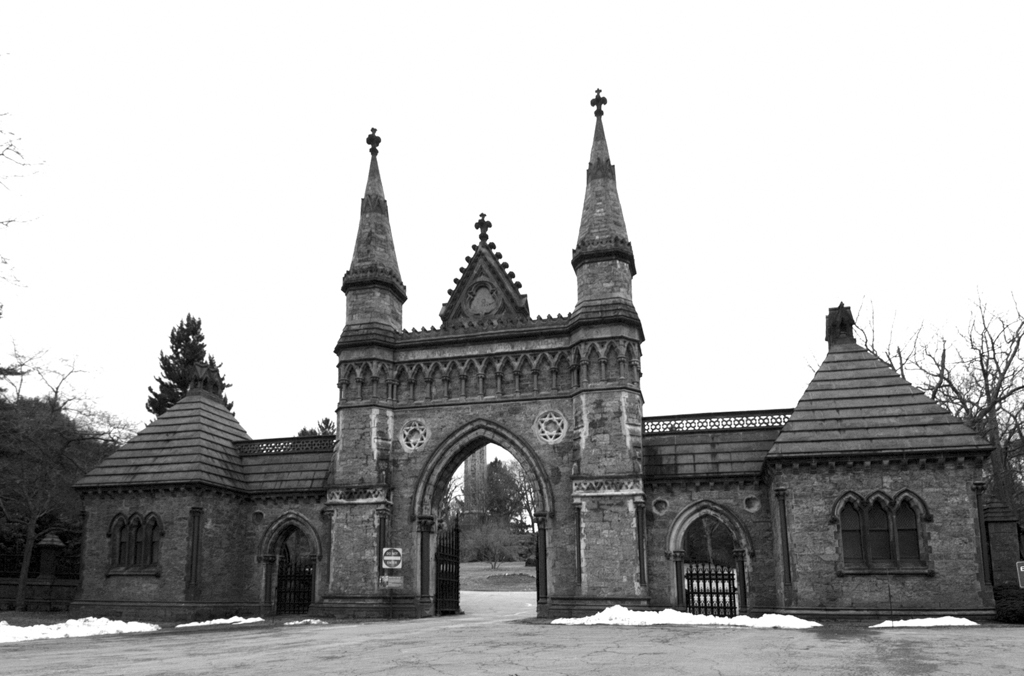
A municipal cemetery of horticultural importance with a nationally significant collection of funerary sculpture, Forest Hills Cemetery joins the Arnold Arboretum (JP4) and Franklin Park (RX28) as the culmination of the circuit of Boston public landscapes. Henry A. S. Dearborn had been the first president of the Massachusetts Horticultural Society and had overseen that organization's efforts to create a horticultural garden at the private Mount Auburn Cemetery (NC1) in Cambridge and Watertown in 1831. When he was elected mayor of Roxbury in 1847, Dearborn made the creation of a public cemetery one of his first priorities. Consecrated in 1848, Forest Hills grew rapidly under Dearborn's guidance. He developed the plan for the grounds and worked with superintendent Daniel Brims to establish the collection of trees. A substantial Gothic Revival entrance gate (1865, Charles W. Panter) built of Roxbury puddingstone greets the cemetery visitor. In similar style and materials, Forsyth Chapel (1884, Van Brunt and Howe) flanks the
Forest Hills Cemetery
 Peter Vanderwarker or Antonina Smith
Forest Hills Cemetery entrance gates
1848, Henry A. S. Dearborn; 1865, Charles W. Panter; 1884, Van Brunt and Howe. 95 Forest Hills Ave.