

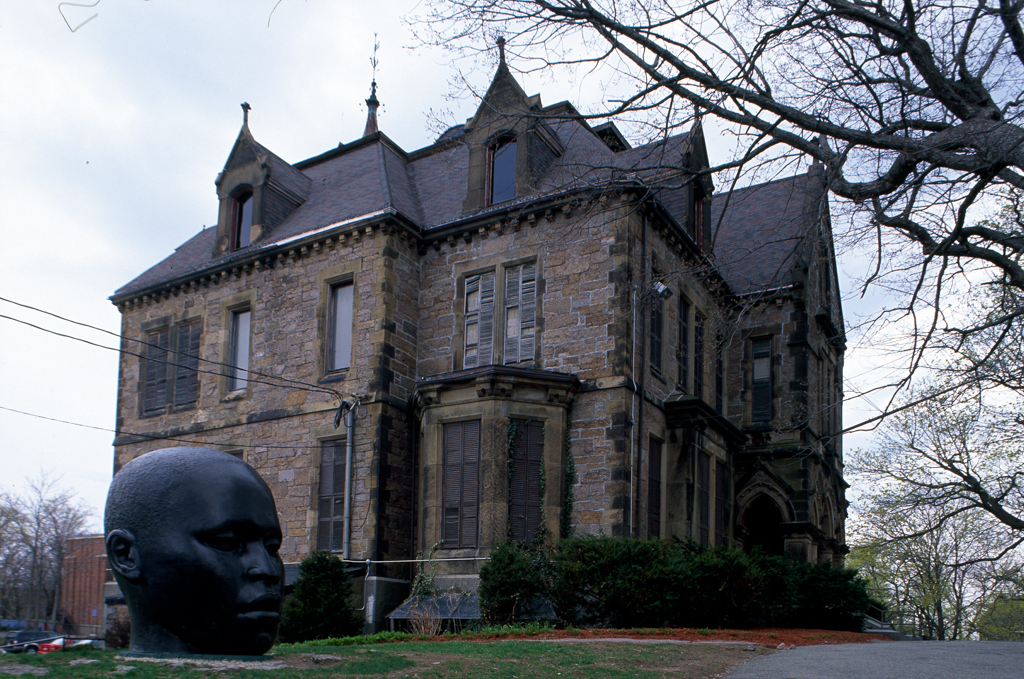
In 1863 Aaron Davis Williams Jr. erected a country home near the site of the family homestead. His father had been prominent in Roxbury's development, and Aaron Jr. became a Boston industrialist and founder of the Boston Leadworks. His great stone mansion, Oak Bend, is constructed of Roxbury puddingstone with sandstone trim in the Gothic Revival style, with porches and bay windows opening the house to the surrounding landscape. Standing on a hill and once part of a great estate, the house, designed by Alden Frink, was the most ambitious structure built in the area. Nothing else known about Frink's work matches Oak Bend in design and scale. When Davis lost his fortune, James M. Smith, a brewer who had a passion for Sir Walter Scott, acquired the estate and renamed the house Abbotsford. Between 1923 and 1975 Abbotsford was used as a disciplinary school for boys by the Boston school system. In 1976, the National Center for Afro-American Artists purchased the property, filling in the windows to create exhibit space. Outside, John Wilson's powerful sculpture Eternal Presence (1987) announces this transformation. Inside, changing exhibits of historical and contemporary material augment the collections of African and African diaspora arts.
National Center for Afro-American Artists, Abbotsford (Oak Bend)
 Peter Vanderwarker or Antonina Smith
The National Center for Afro-American Artists, Abbotsford (Oak Bend)
1872, Alden Frink. 300 Walnut Ave.