

Highland Park (NR), the site of one of the important Revolutionary War forts built during the siege of Boston in 1775, caps the hill. At that time the hill offered a commanding site overlooking the only land bridge to Boston, where the British army was stationed until forced to abandon the city. Early efforts to preserve the fort failed, and in 1869 the site was used to construct a standpipe for Boston's Cochituate Water System. Designed by Nathaniel J. Bradlee, it is a fitting monument to the architect-engineer who was known for his leadership in the construction of the reservoir systems at Parker and Chestnut hills. The Gothic-style brick tower served as an ornamental landmark in the center of the park,
CH6
) in Charlestown. At its centennial in 1875, efforts began to commemorate the site of the fort. Between 1895 and 1916, the Olmsted Brothers designed improvements to the park, which included features that approximated the configuration of the fortifications. The standpipe is no longer open to the public.
Highland Park and Roxbury Standpipe
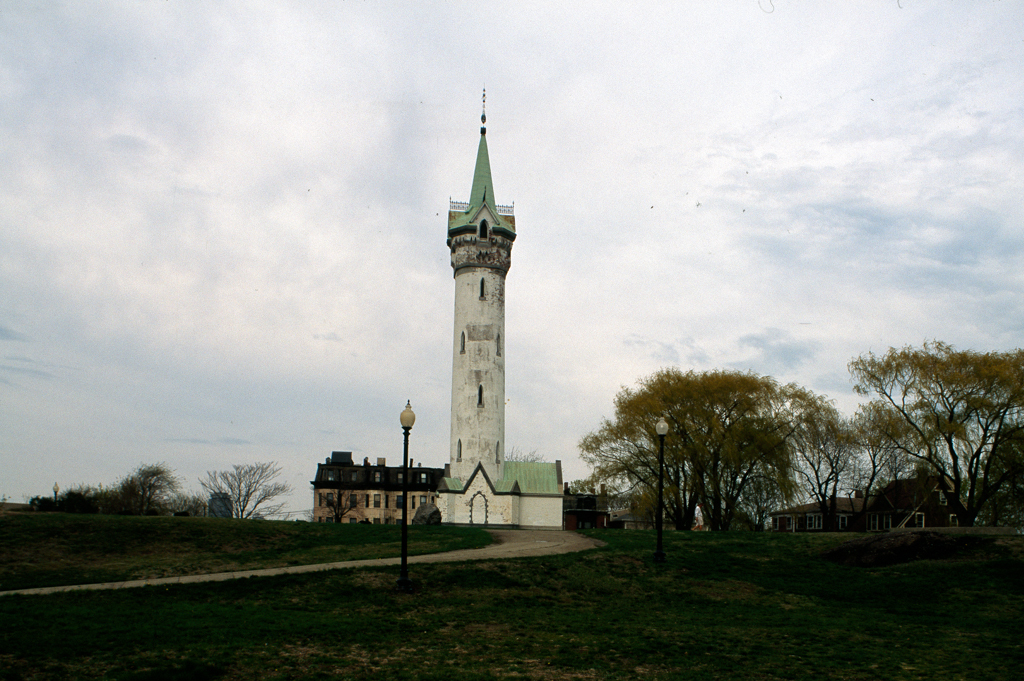 Peter Vanderwarker or Antonina Smith
Highland Park and Roxbury Standpipe
1775–1916. Highland Park.