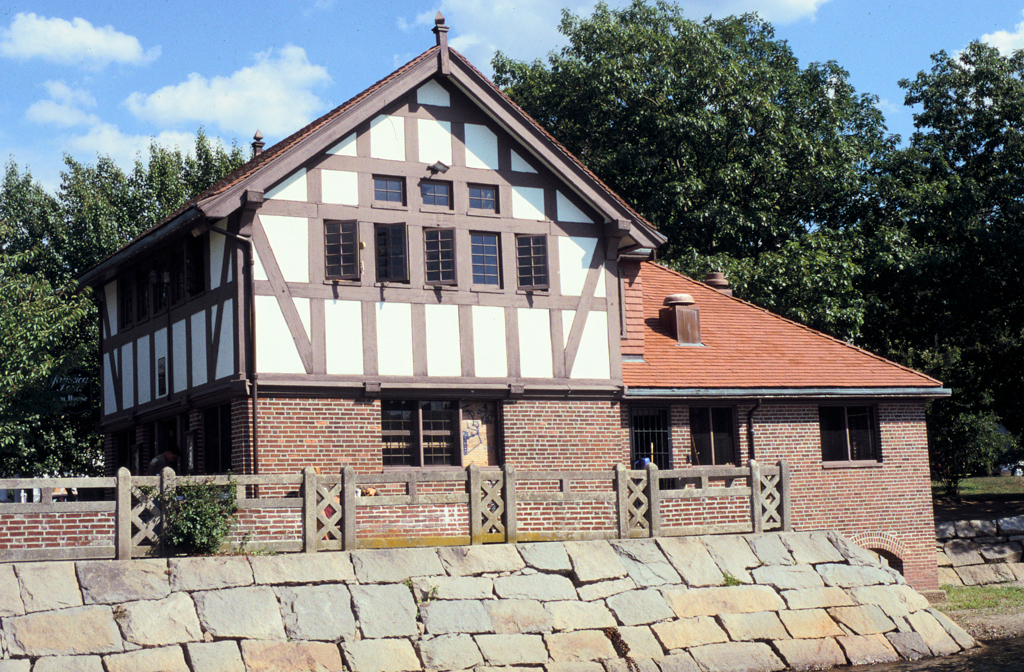
Long the site of country estates, Jamaica Pond became an important node in the string of parks Frederick Law Olmsted designed for Boston by virtue of its existing qualities rather than through radical reshaping. Evidence of these earlier uses can still be seen in Pinebank (1868? Sturgis and Brigham), the last of three houses on this site built by the Perkins family and one of the earliest examples of Queen Anne architecture and uses of terra-cotta in Boston. Olmsted did little to convert the pond to a public park, in part because the Boston Park Commission was able to afford so little of the adjacent land. To facilitate the popularity of boating on Jamaica Pond, William D. Austin designed a half-timbered boathouse in 1913 near the intersection of Pond Street with Jamaicaway.

