

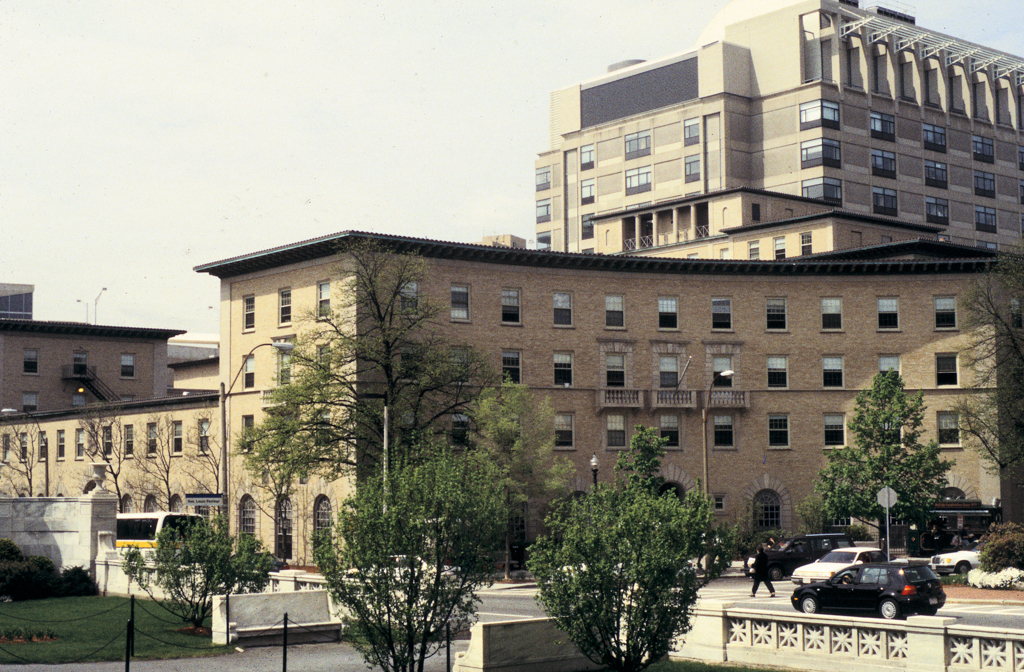
Founded in 1832 as a maternity hospital for “deserving married women … and unmarried women [of] good character,” Boston Lying-In Hospital moved to its fourth location in 1923 as part of the Longwood hospital district expansion. Coolidge and Shattuck organized the tan brick and limestone, Renaissance Revival design around an irregular U-shaped court with the entrance pavilion (now badly altered) and operating and delivery rooms at the base of the U, the nurse's residence to the right, and the hospital wards (Richardson House, 1929) to the left. The Boston Society of Architects awarded their first Harleston Parker Prize to the architects for this building. Tsoi/Kobus has recently inserted the Longwood Medical Research Center, sympathetic to the original complex in material, color, and massing, and an expansion and renovation of the former nurse's residence.
Across Avenue Louis Pasteur, the successor firm designed Vanderbilt Hall, a luxurious residence for students at the adjacent Harvard Medical School. At the intersection with Longwood Avenue, the architects inwardly curved the facades of both Boston Lying-In Hospital and Vanderbilt Hall as part of the grand civic approach to the medical school. One of the first residence halls built for students in a professional program at an American university, Vanderbilt Hall also provided handsome public spaces, a dining room, and recreation facilities for the doctors in training.