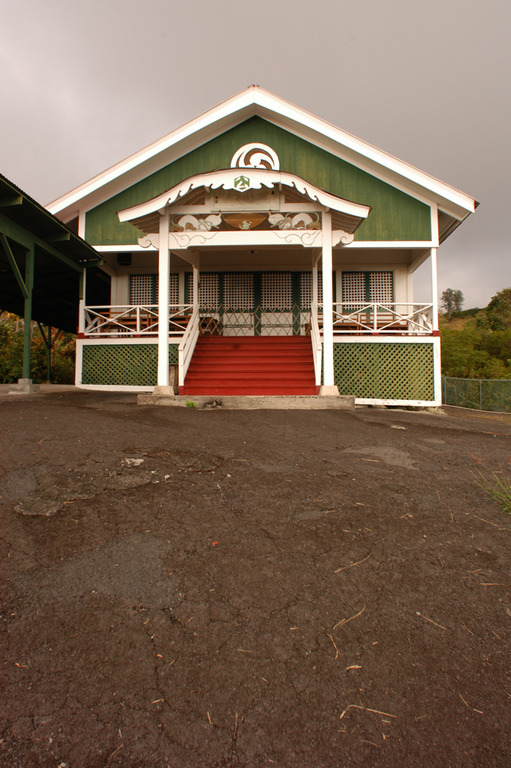
Originally an odaishi (community-based temple), this seemingly simple single-wall, gable-roofed building is splendidly detailed. From the carved beams of its modest kōhai (portico), featuring cutout images of a saki cup and two saki bottles, to the naturally unfinished wooden Honden (the space for the Gods) at the rear, the temple is finely embellished. The mitsu tomoe (three-part swirl pattern) in the front gable signifies the eternal circle of life, and the kanji (Japanese logographic writing system) for “longevity” is on the saki cup. The Honden is a type rarely found in Hawaii. The building presently serves as a nondenominational mission under the administration of the Kona Hongwanji.

