

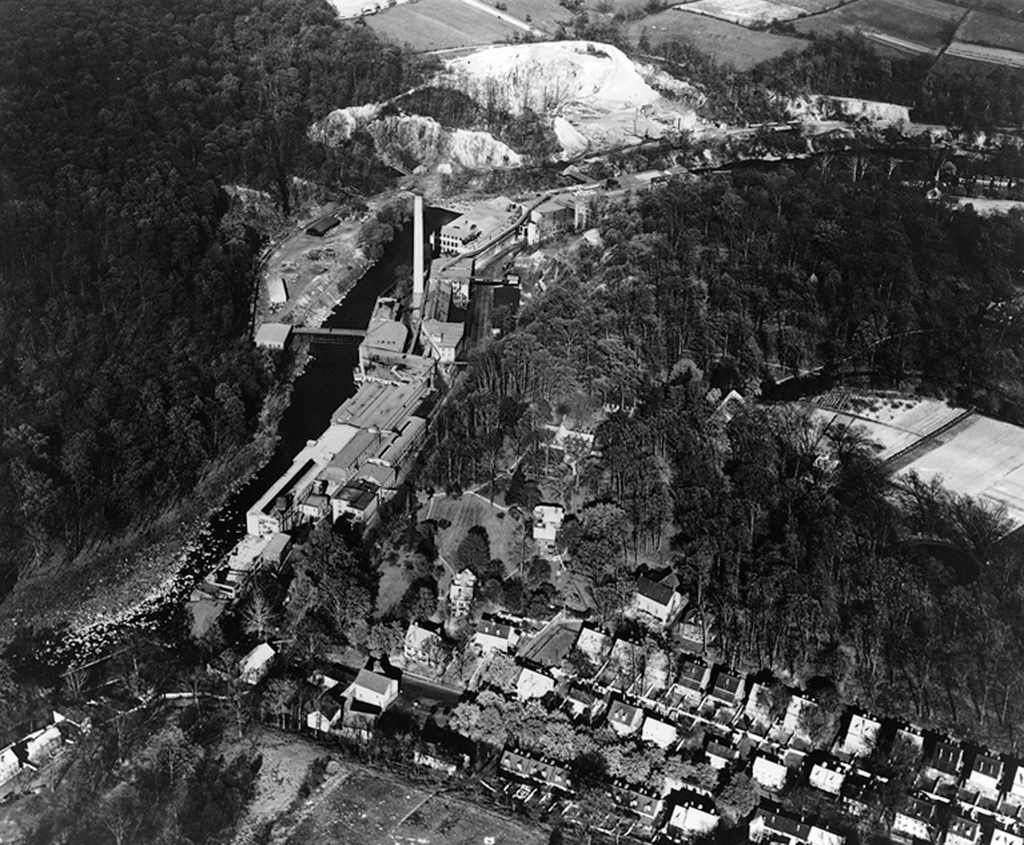
English-born Quaker Joseph Bancroft was trained in cotton weaving in Lancashire. He bought a grist mill here in 1831, at a time when grain milling was on the decline. He switched it over to cloth making, specializing in glazing fabric for awnings, tents, and especially window shades. In 1859–1860, Bancroft added bleaching and dyeing equipment. By the 1880s, the firm was the largest textile finisher in the nation, with its brick and stone mills sprawling along the riverbank. Bancroft built worker housing in Rockford Village on Rockford and Ivy roads. His son donated land uphill from the mills for Rockford Park in 1889 and 1895 (see
Kentmere Parkway and Rockford Park
). As late as the 1940s, this was called the largest cotton dyeing and finishing plant in the world, with a soaring, 250-foot yellow-brick smokestack (by Heinecke, a New York firm, 1911). Bancroft Mills was bought out in 1961 and later closed. Only part of the extensive original complex survives, and, in 2007, a developer proposed demolishing most of the toxics-laced remainder and building condominiums.
Bancroft Mills
 Hagley Museum and Library
Bancroft Mills
Mid- to late-19th century and later. Foot of Rockford Rd. at Brandywine Creek