

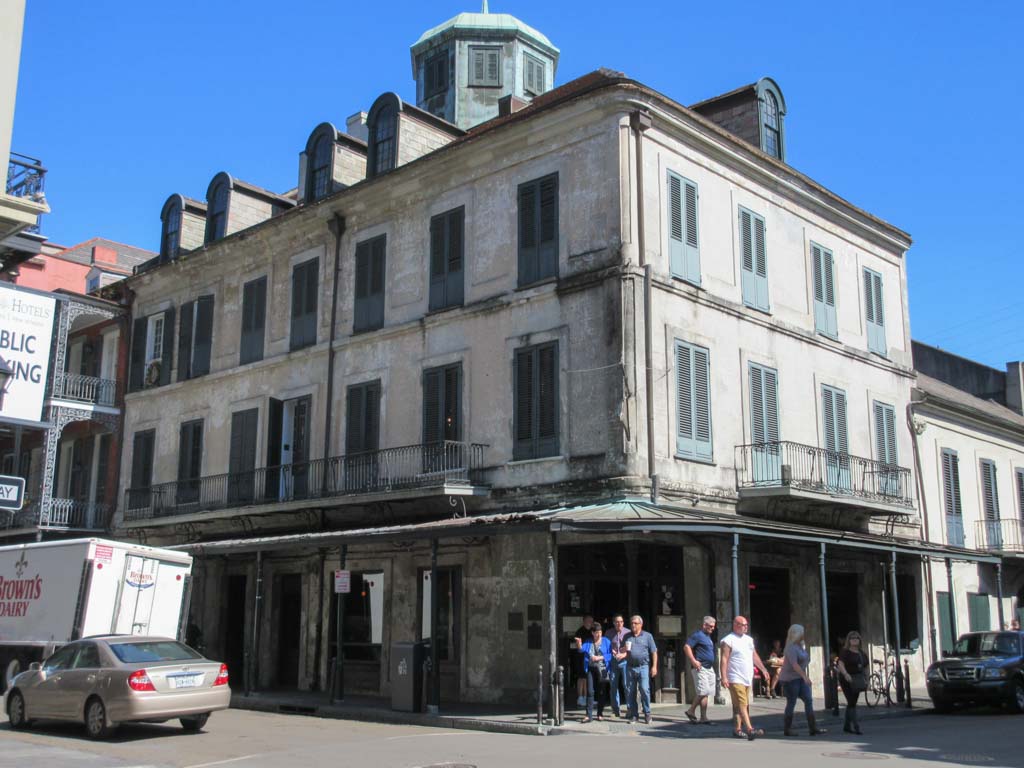
J.-H. Laclotte (1766–c. 1829), from Bordeaux, studied at the Ecole des Beaux-Arts in Paris before arriving in New Orleans in 1806. He built this three-story residence for Nicholas Girod, mayor of New Orleans from 1812 to 1815. The ground story of the plastered brick building was used for business purposes and, in typical French fashion, opened directly onto the street by means of casement doors; the principal living spaces, with higher ceilings, occupied the second floor. The house was innovative in New Orleans, however, for its use of tall proportions. Curved-arched dormers and an octagonal cupola mark the hipped roof. A carriageway led from St. Louis Street into a two-story wing, dating from 1795. It is believed that Girod, one of the leaders in the plot to rescue Napoleon, wanted his house to serve as a refuge for the emperor after his escape from Elba, but Napoleon was subsequently sent to St. Helena, where he died in 1821, thus dashing Girod’s hopes. However, it is claimed that Napoleon’s physician, Dr. Francesco Antommarchi, maintained an office here about 1838, where he treated the poor without charge. By 1860, the building was an auction house, and in 1914 it became a bar. Today it is a popular bar and restaurant. The original courtyard has long been divided by a masonry wall.
Napoleon House (Girod House)
1814, attributed to Jean-Hyacinthe Laclotte. 500–506 Chartes St.