

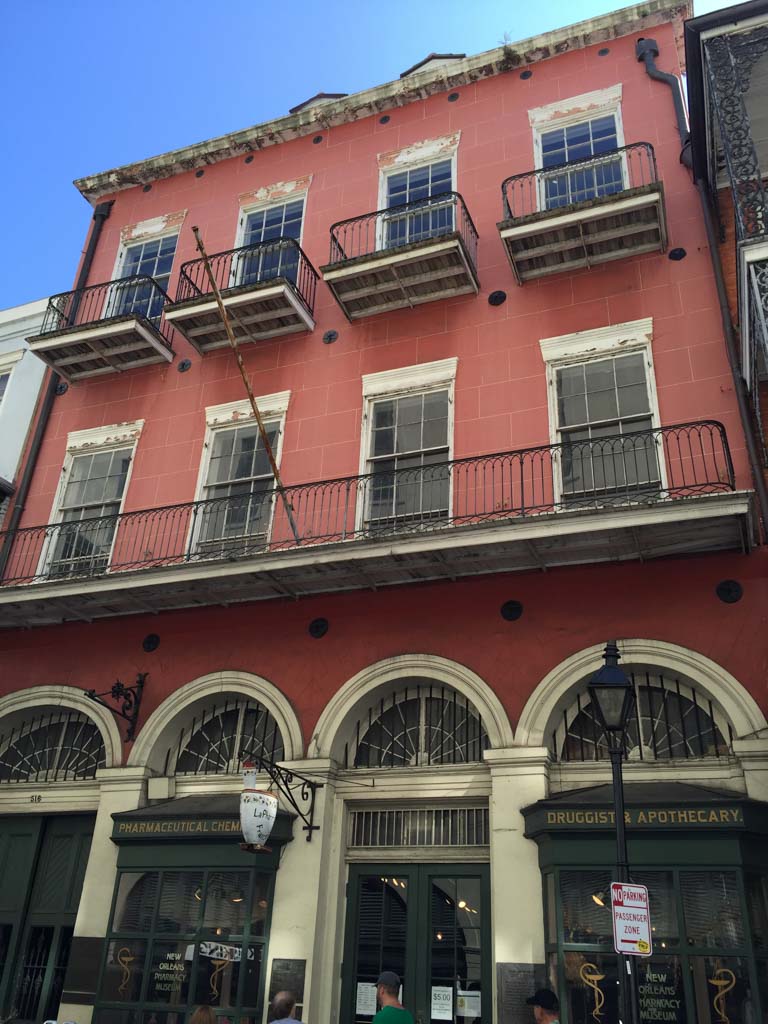
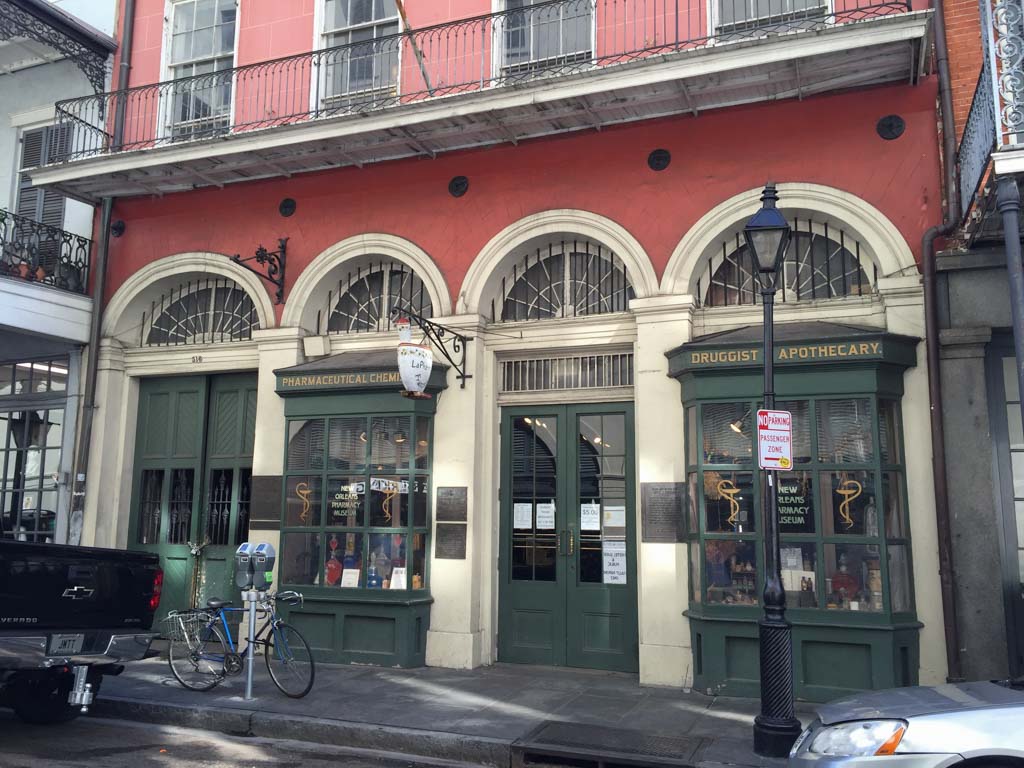
Louis J. Dufilho Jr., one of the first licensed pharmacists (1816) in the nation (Louisiana passed a law in 1804 requiring a licensing examination for pharmacists), acquired the site on which the building now stands in 1822. The present building is either a remodeling of his apothecary shop and residence built in 1823, or a new structure of 1837. Dufilho’s apothecary shop and residence is in the style of a typical Creole-American town house. The three-story building is brick covered with plaster. Three large round-arched openings in the lower facade are matched by a similarly shaped carriage entrance at one side. An entresol between the first and second stories is lighted by the upper portion of the window arches. A botanical garden in the courtyard supplied Dufilho’s medicinal herbs. Dufilho sold the building and its contents in 1855 and it subsequently changed hands and uses several times. In 1937, then-mayor Robert S, Maestri purchased the building and donated it to the City, which restored it and opened it as a pharmacy museum in 1950. Since 1987, a nonprofit organization has operated the museum. The courtyard has recently been replanted with medicinal herbs.
Pharmacy Museum (Dufilho’s Pharmacy)
1823; 1837, J. N. B. de Pouilly. 514–516 Chartres St.