

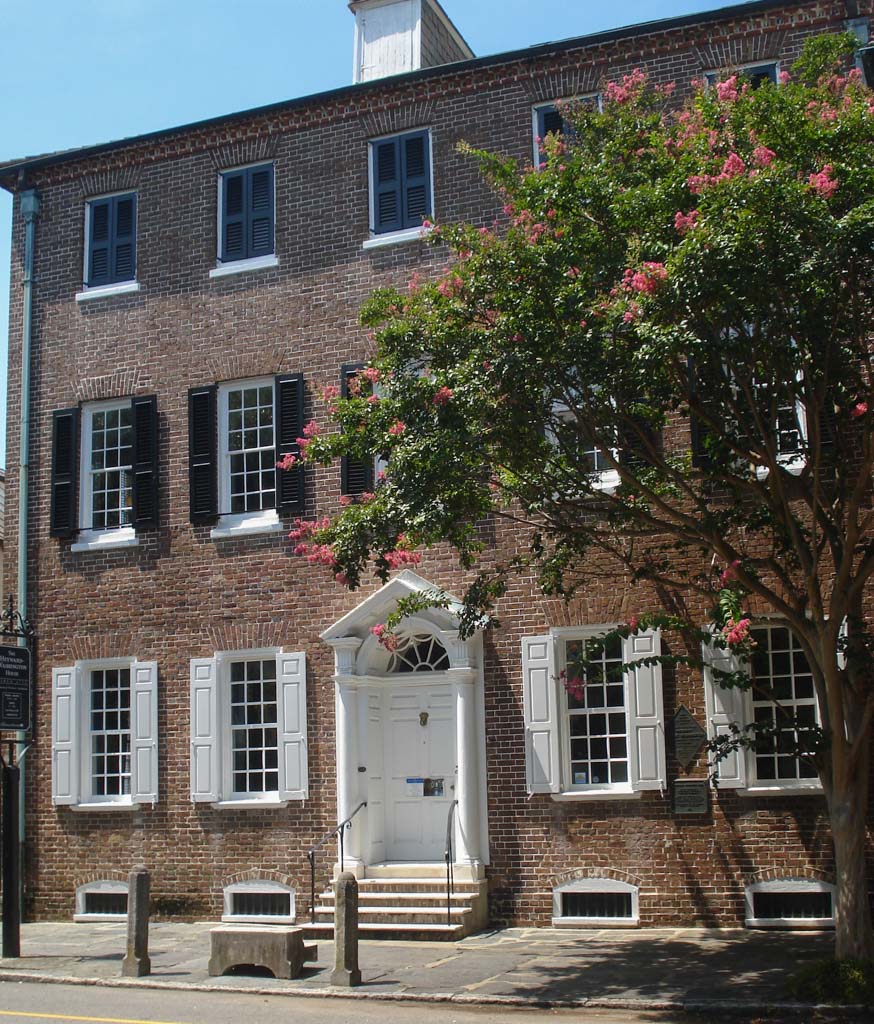
Thomas Heyward, one of four South Carolinians to sign the Declaration of Independence, acquired this property just north of Tradd Street from his father, rice planter Daniel Heyward, in 1770. After razing an older dwelling on the site, Heyward began construction of a three-story brick residence the following year. He retained the prior residence’s kitchen and stable outbuildings that frame a courtyard at the rear of the new structure. Brick jack arches over the windows are the only exterior ornamentation of the central hall, double-pile house. Following the pattern of many Charleston merchant/planter residences, Heyward placed the principal entertaining rooms on the second floor. There, a large, fully paneled drawing room and a smaller withdrawing room overlook Church Street. President George Washington rented this residence when he stayed in Charleston for a week during his 1791 tour of Southern states.
By the end of the nineteenth century, a bakery operating out of the house installed a storefront sales room on the first floor, enlarging the windows and installing a door in the three southernmost bays. The Charleston Museum initiated a purchase of the house in 1929 with assistance from the Society for the Preservation of Old Dwellings. The Museum engaged the local firm of Simons and Lapham, Architects, to both document and restore the house. Simons and Lapham’s conjectural restoration of the raked architrave of the front doorway was based on their close study of Charleston precedents, and their investigation of the altered first floor discovered evidence of the original plan of the stair hall and first-floor front rooms.
When the Heyward-Washington House was opened to the public following its restoration, it became Charleston’s first historic house museum. It is owned and operated by the Charleston Museum and remains open to the public.