

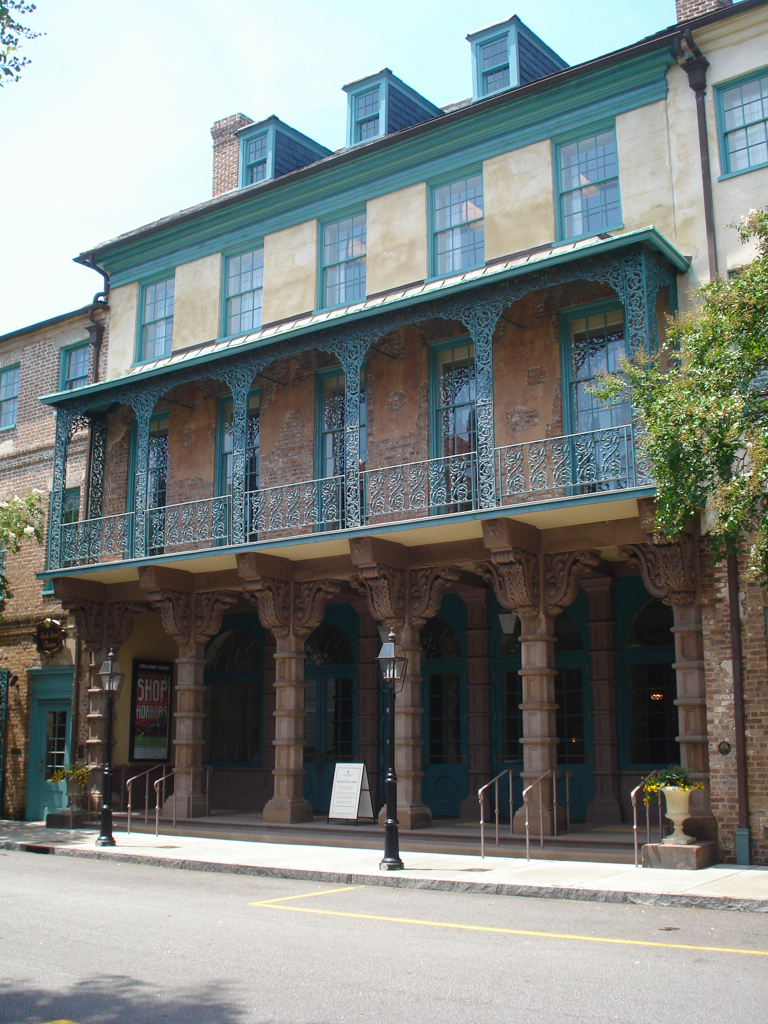
Only fragments remain of the brick structure that was possibly the second in America built specifically for theatrical performances. Raised in 1736 and rebuilt in 1754 after it was destroyed by fire, by the end of the eighteenth century the theater closed and became derelict. In 1809, Alexander Calder (ancestor of the twentieth-century sculptor of the same name) purchased the former theater building and adjoining properties and fashioned them into the Planter’s Hotel. This, Charleston’s first major reported hotel, was situated at Church and Queen streets in the very heart of the city. Renovations and improvements in 1835 revealed Calder’s efforts to attract and accommodate wealthy guests. These improvements included the addition of an ornate Italianate loggia supported by banded brownstone columns topped with carved wooden brackets that, in turn, support an elaborate cast-iron balcony.
In 1935, funds from the Works Progress Administration (WPA) supported rehabilitation of the building and creation of a new theater. Albert Simons, a local architect then gaining a reputation as a leader in Charleston’s early historic preservation movement, headed the effort to recreate an eighteenth-century theater inside the shell of the Planter’s Hotel. Inside the former hotel’s entrance loggia, Simons’s placed a large lobby and monumental stairs leading to the balcony level. At the same time Simons was working on the hotel’s conversion, he was overseeing the demolition of the late-eighteenth-century Radcliffe-King House on Meeting Street and he installed elements of its neoclassical interior, including sections of its cornices, mantels, and door and window architraves, in the new theater’s public rooms. The design of the new theater included the coat-of-arms of George II hung at the apex of the proscenium arch, thus providing a symbolic visual link between the original theater and its modern recreation.
Managed by the city of Charleston, Dock Street Theatre hosts theatrical and musical performances throughout the year, including the popular Chamber Music series presented annually during the Spoleto Festival USA.