

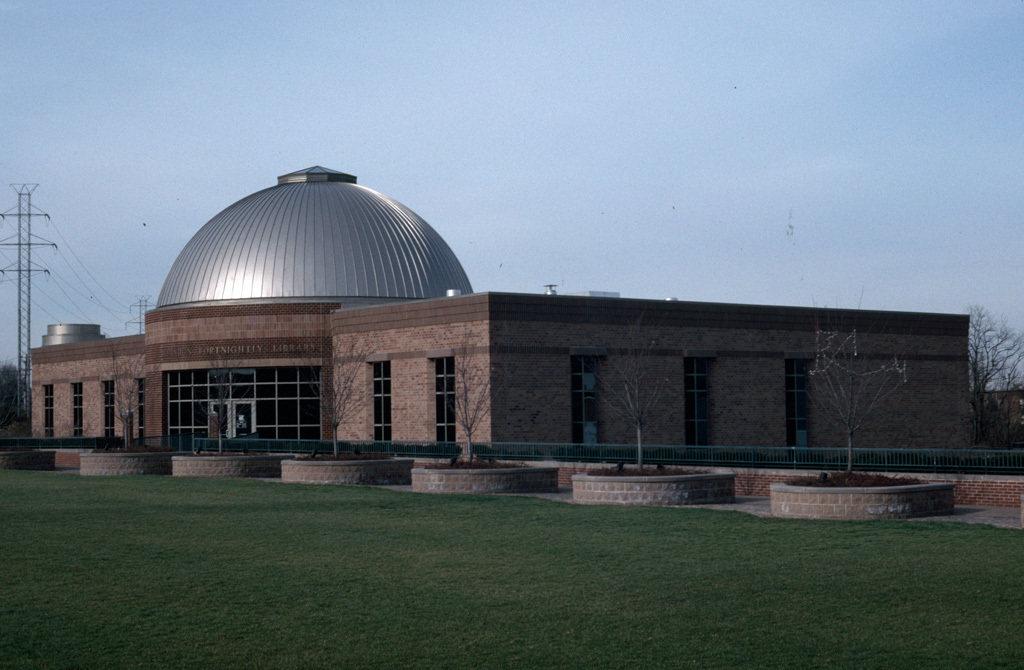
Now overrun by intense development and automobile traffic, the center of Herndon tries to maintain its earlier farming community atmosphere. Virginia 657 and 606 (Centerville Road, then Elden Street, and then Washington Street) bisect the center of town.
Herndon traces its development to the Alexandria, Loudoun and Hampshire Railroad, which passed through in the mid-nineteenth century. At the center are the Herndon Depot (1857) and the town green. The depot is one of the earliest surviving Virginia board-and-batten stations; well maintained, it now serves as the Herndon Historical Society Museum and other offices. Around the depot grew up a commercial and residential core that still contains some buildings of interest. Across is the Town Hall (1939; 730 Elden Street), an unassuming Colonial Revival brick structure that originally housed the post office on the first floor. Adjacent is the recent Herndon Municipal Center (master plan, 1993–1995, Cooper-Lecky), a group of buildings clustered around an extension to the town green. Underneath the complex and town green is a parking garage reached from the glazed gazebo on the south side. The site was a brownfield, or polluted tract of land, reclaimed for the new municipal use. The Herndon Council Chambers (1993–1995, Cooper-Lecky) is one of the