

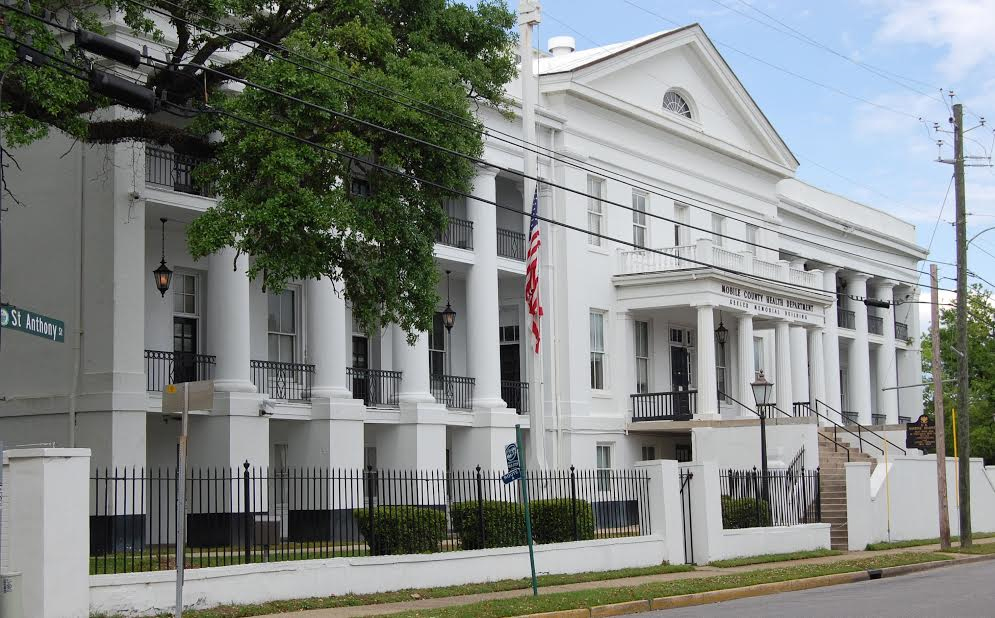
Three years after the City of Mobile completed the adjacent municipal hospital, the federal government began construction of a second medical facility just to the east. The U.S. Marine Hospital was one of several such institutions around the country built for the care of mariners during the heyday of commercial navigation. The Mobile hospital served that purpose from its opening in 1842 until it closed 110 years later. During the Civil War, it also doubled as a military hospital.
Though slightly smaller in size than the City Hospital next door, the building adheres to the same basic template: a central pavilion with colonnaded wings. Here, however, a full-height entrance portico has been replaced by a more modest affair with an open, balustraded deck at the second floor. Except for a semicircular fanlight in the pedimented facade of the main block, detailing tends toward the Greek Revival. The deep, pillared galleries extending to either side are defined by simple, wrought-iron railings and recesses between solid masonry walls finished as heavy Grecian pilasters with molded caps and bases. A pair of diminutive side porticos echo the austere classicism of the facade. Long-gone louvered shutters and the multi-pane sashes (12-over-12 below, 8-over-12 above) that once filled the windows would have softened the present unrelieved expanses of white stucco. Only part of the wall that once surrounded the hospital grounds still stands. In 1931, the Birmingham architectural firm of Warren, Knight and Davis added a T-shaped wing to the rear. Subsequent construction gradually encroached on the expansive grounds that stretched to the rear in the nineteenth century.
Early drawings of the interior, now much altered, show open wards, reception and service areas, and a separate “colored ward” for African American patients. In the 1970s, the building was acquired by the Mobile County Board of Health and later rededicated as the Major William C. Gorgas Clinic.
Like its companion City Hospital to the west, the former Marine Hospital continues to serve the community—albeit in an environment far different from the sylvan setting of the 1840s.