

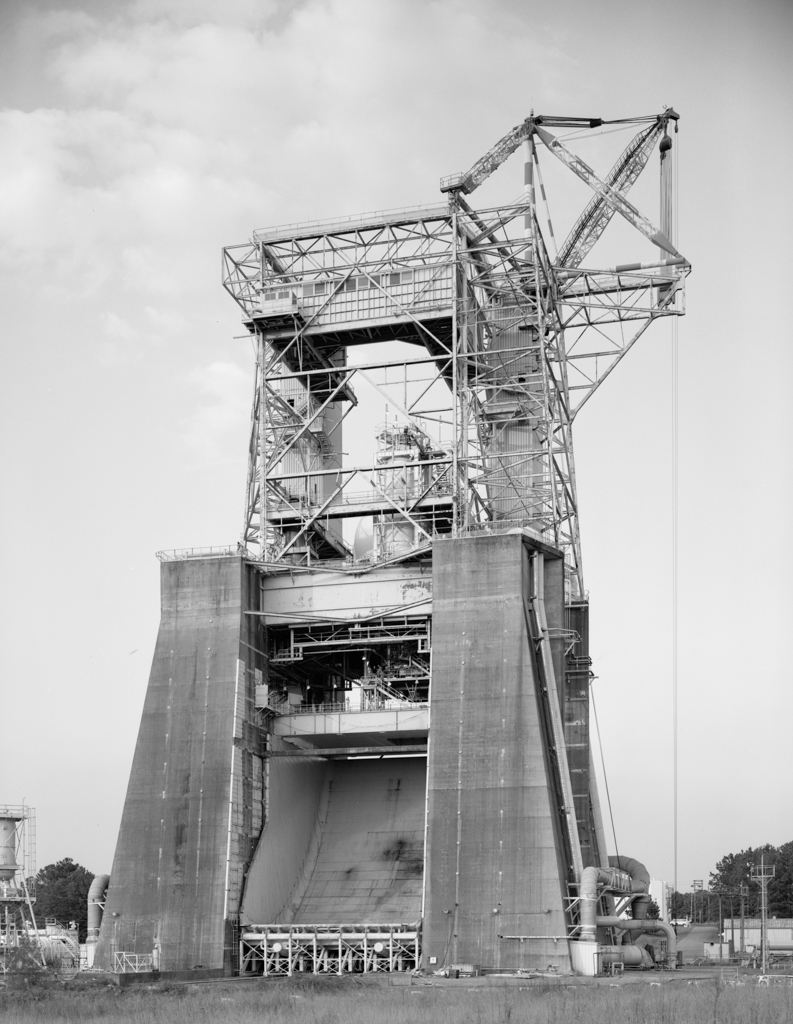
The Saturn Static Test Stand, alternately known as the S-1C Test Stand, was designed and engineered for the Saturn V first stage booster. The stand is approximately 405 feet tall with a base of 164 x 164 feet in footprint. There are four concrete pylons rising at the corners of the stand with a 32-foot-deep substructure. Designed in 1961, the test stand was used to captive-fire the Saturn V (C-5) booster, the largest rocket then in development. The structure was designed to accommodate test articles up to 178 feet in length and 48 feet in diameter with up to 12 million pounds of thrust.
As of April 1965, NASA engineers ran short single-engine firings of the Saturn V at the Static Test Stand. Later that year the engineers tested the S-1C booster with five F-1 engines having a combined thrust of 7.5 million pounds. The first tests were 15-16 seconds in duration with later tests increased slowly to a full-length firing time of 2.5 minutes. Following Saturn testing at 4670, the stand was used for Space Shuttle and other advanced engine testing.