

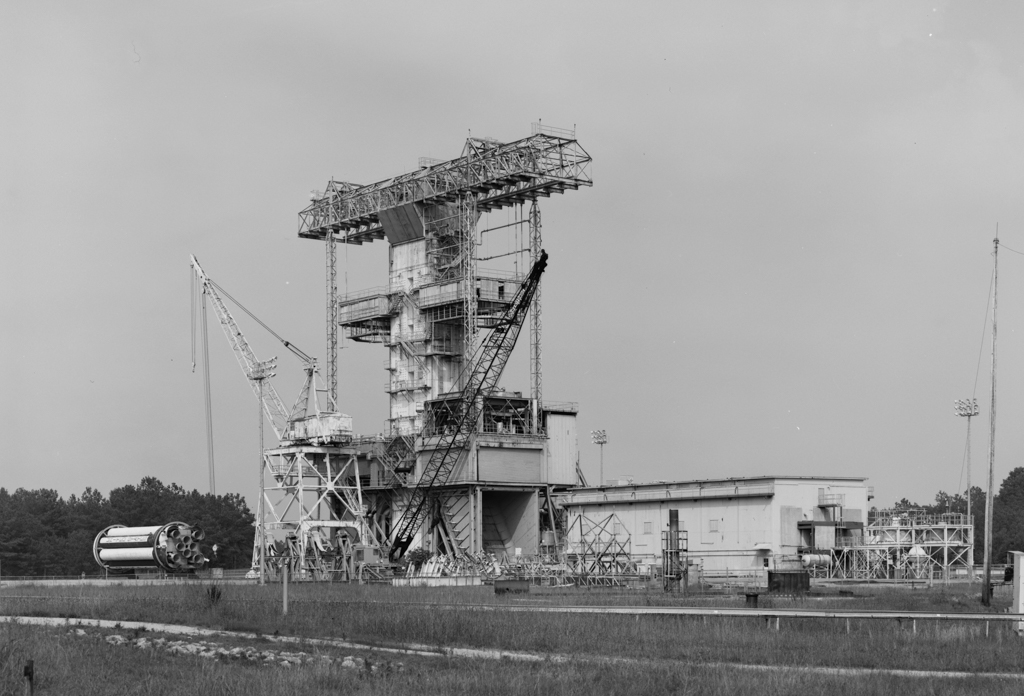
The Static Test Tower is the first permanent test stand designed for the Redstone Arsenal, following the interim facilities of Structure 4665. The Army’s need for a permanent facility for testing rockets led to the construction of this facility in 1953–1954. Comprising a test stand and a 45-ton revolving gantry crane used for loading test articles, the stand is a “T” configuration consisting of two test positions. Overall height of the structure is 175 feet with the upper steel “T” truss-work extending east-west approximately 160 feet at the top of the test stand. The Army and NASA improved the static testing capacity of the structure multiple times, augmenting the test positions to accommodate increased pounds of thrust. By 1961, the west position could test articles up to 500,000 pounds of thrust, while engineers had enhanced the east position to 1.5 million pounds of thrust.
The Army and NASA tested the Redstone, Mercury-Redstone, Jupiter, Juno, and Saturn rockets, and the solid rocket booster for the Space Shuttle in the two positions of the stand. After modifying the stand to enhance its testing capacity in 1963, NASA tested the new F-1 engines that would be used in the Saturn V rocket.