

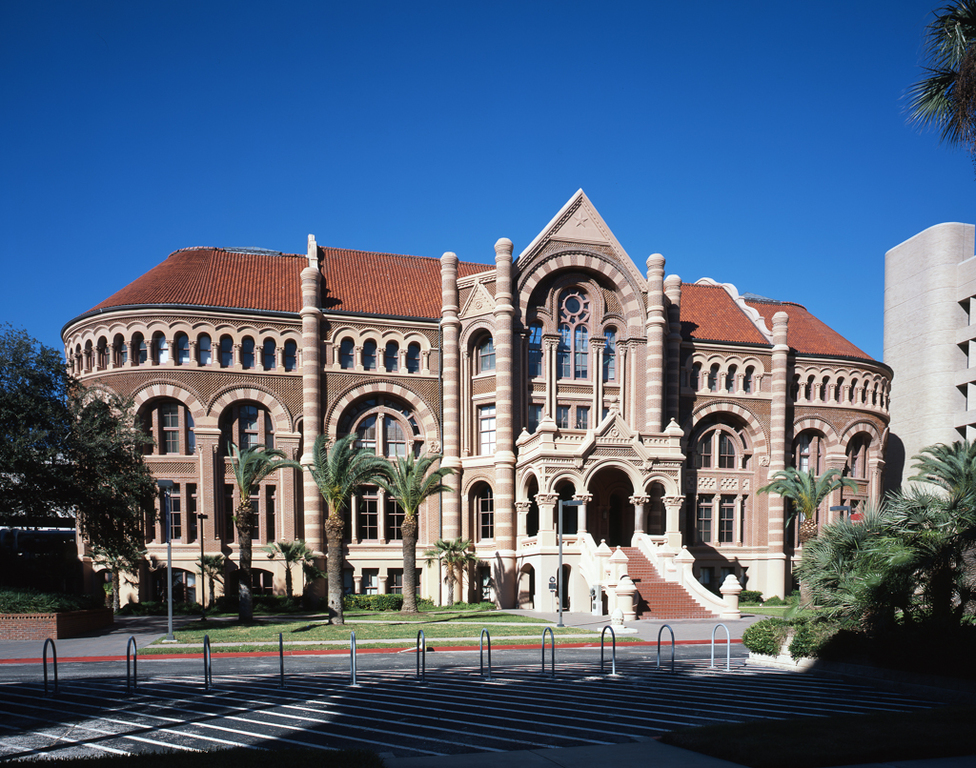
Clayton was so prolific in the 1880s and 1890s, and so accomplished, that it is tempting to assign the term “masterpiece” not to a single building but to distribute it among different building types. His educational masterpiece is the University of Texas Medical Department Building, now affectionately called “Old Red,” constructed to house the first public medical school established in, and by, the State of Texas. It was built in tandem with a second Clayton design, no longer standing, John Sealy Hospital of 1889, which John Sealy's widow, Rebecca, and his brother George built as the university's teaching hospital in order to entice the university to locate its medical school in Galveston. By the early twenty-first century, the complex of hospitals surrounding the medical school is Galveston's principal employment center.
N. J. Clayton's building is a tripartite composition of rising centers and framing ends, reiterated with ever-finer degrees of differentiation. Clayton managed to vividly spatialize this formula by exploring the permutations of circular geometry in line, shape, and volume. The building front is organized as a powerful composition of major and minor arches. Red Texas sandstone and intensely red brick imbued the building with a sense of emotional depth that is exceptionally compelling even among Clayton's buildings. It is difficult to judge whether it is the entrance porch, with its splayed ramped stair framed beneath a gabled central arch, or the rounded west and east end bays, with their second-floor spandrels dissolved in lush fields of opus spicatum, that is the more affecting. Clayton achieved a remarkable sense of perceptual engagement with Old Red. This is architecture that profoundly moves the observer.