

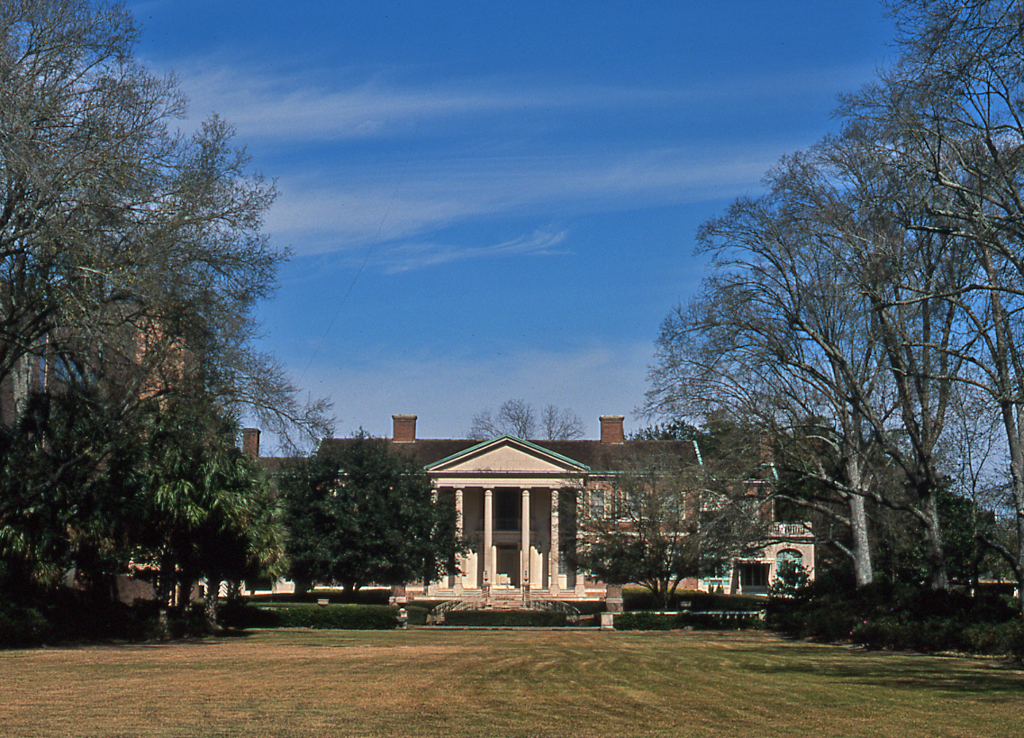
In 1917 John Henry Phelan began financially backing M. Frank Yount's oil exploration activities, becoming secretary-treasurer of the Yount-Lee Oil Company. When Yount struck it big by reopening the Spindletop field in 1925, Phelan not only retired from the wholesale grocery business but bid his wife, Johanna Cunningham, to build her dream house. “Céad Mile Fáilte” (“A Hundred Thousand Welcomes” in Gaelic: inscribed on the gate pier at Calder Avenue and 11th Street) was one of the most expensive houses built in Texas in the 1920s; the construction contract was let for $355,000. Occupying a thirty-acre site on what was then the west edge of Beaumont, the neo-Georgian country house is built atop an artificial mound. A pedimented, limestone-cased portico, inset behind Adamesque columns, faces south toward Calder across a wide turf terrace framed by avenues of willow oak and palm trees. A ramped driveway ascends to the portico from the entrance gate at 11th Street. According to Beaumont historian Howard Perkins, Johanna Phelan had promised Southwell, an aspiring architect and the son of a Beaumont builder, that if she ever built a house he would design it. She made good on her pledge, bringing Southwell back to Beaumont from Atlanta, where he had established a practice, for the occasion. Homer Fry of San Antonio was the landscape architect. Shortly before his death in 1957, John Phelan gave this property to the Sisters of Charity of the Incarnate Word, which built what is now Christus–St. Elizabeth's Hospital on the west half of the tract. The house has been preserved by the order as a convent and the garden parterre and parklike grounds are well maintained.
Céad Mile Fáilte
1929, Owen J. Southwell and Livesay and Wiedemann. 2810 Calder Ave.