

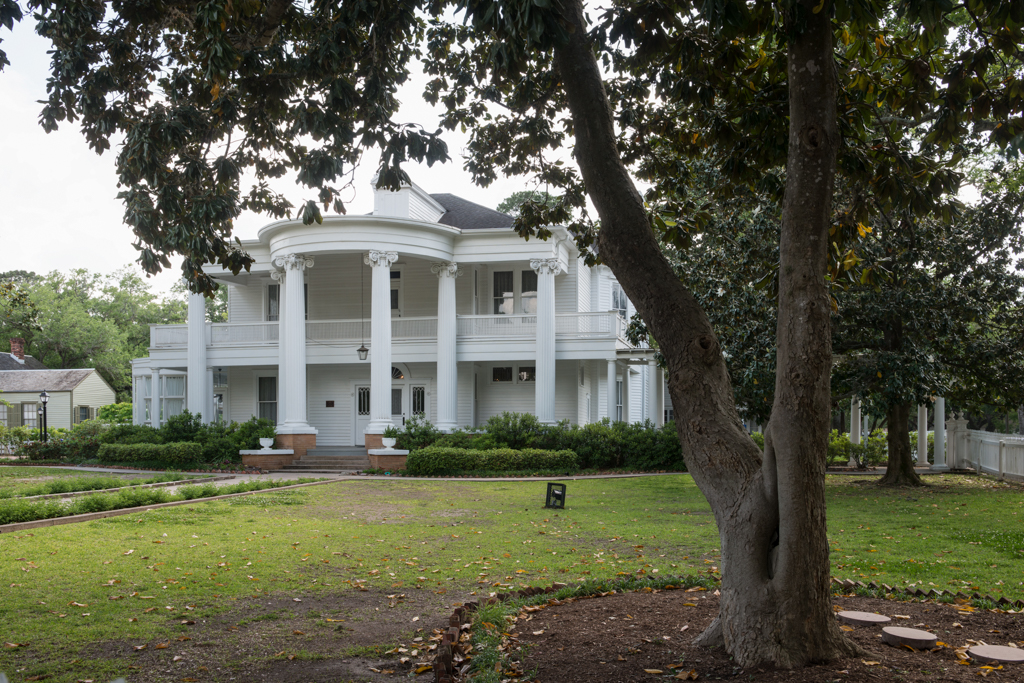
The assertive semicircular portico of the former house of Lottie Dyer and John M. Moore, carried on fluted Ionic columns, was meant to camouflage its episodic construction. The pair of two-over-two windows to the left of the second-floor porch door discloses the nature of the house's architectural evolution from a two-story towered villa into a Colonial Revival showplace. Charles H. Page sought to mask the anomalies this transformation entailed with the flamboyant portico. The Moore House is now a historic house museum operated by the Fort Bend Museum Association.
On the same block, at 500 Houston Street, is a one-story wood cottage dated to 1837 that the Fort Bend Museum Association moved to this site and also operates as a historic house museum. Originally built on property owned by Jane Wilkinson Long, the three-bay cottage has a gabled front porch, another characteristic cottage type of the pre–Civil War era. The Richmond Historic District contains other interesting examples of nineteenth-century house types in varying states of preservation.