

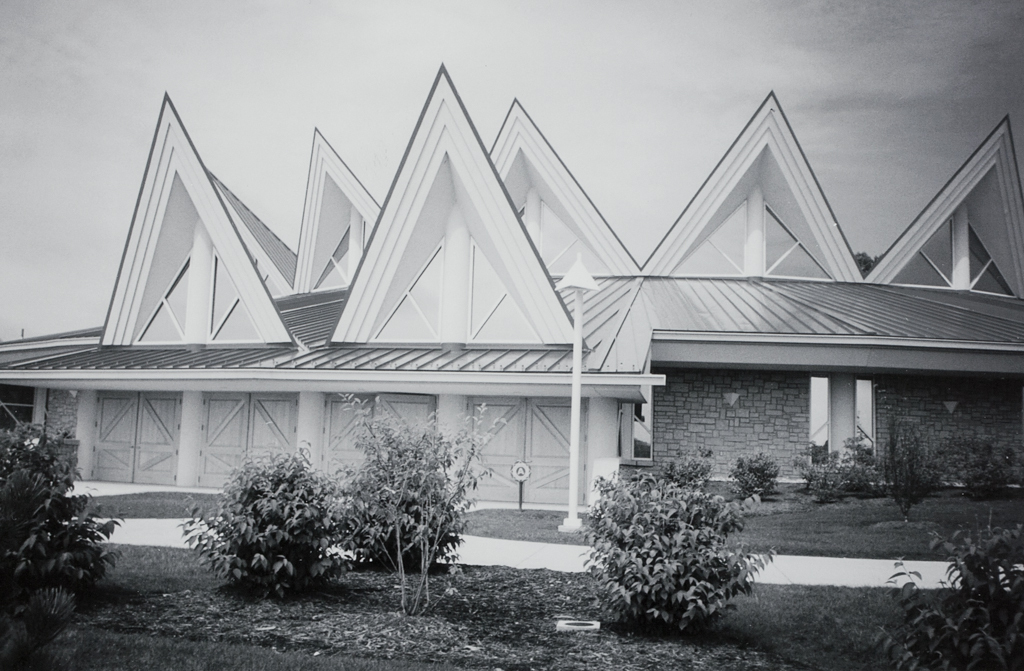
Tamarack is one of the youngest buildings featured in this book and, at a cost of $18 million, one of the most expensive as well. It is also one of West Virginia's most blatantly visible buildings, colorful to a fault, and strategically situated where a $17 million access road connects it to the West Virginia Turnpike at Beckley's western outskirts. Tamarack is another name for the eastern larch, a tree of great strength and one that was often used as supports in coal mines. Other than sharing a name, the tree and the building have nothing in common.
Tamarack, whose secondary name is “The Best of West Virginia,” was designed to showcase and market the state's handicrafts and agricultural products. The West Virginia Parkways Economic Development and Tourism Authority sponsored the combination exhibition space, market, demonstration area, restaurant, and theater, all housed in a 59,000-square-foot, lowslung circular stone structure surrounding an open courtyard. The source of the building's shape and design emanates from the starburst pattern of a traditional Appalachian folk quilt. Its architectural trademarks are spiky triangular windows emerging from a standing-seam metal roof, supposedly reminiscent of the state's mountains. All roof surfaces (and there are many) are painted a vibrant red, ensuring that the building will stand out from its surroundings, an increasingly motley collection of motels, service stations, and fast-food enterprises.
Although it may have been inspired by folk art, Tamarack's first impression is one of