

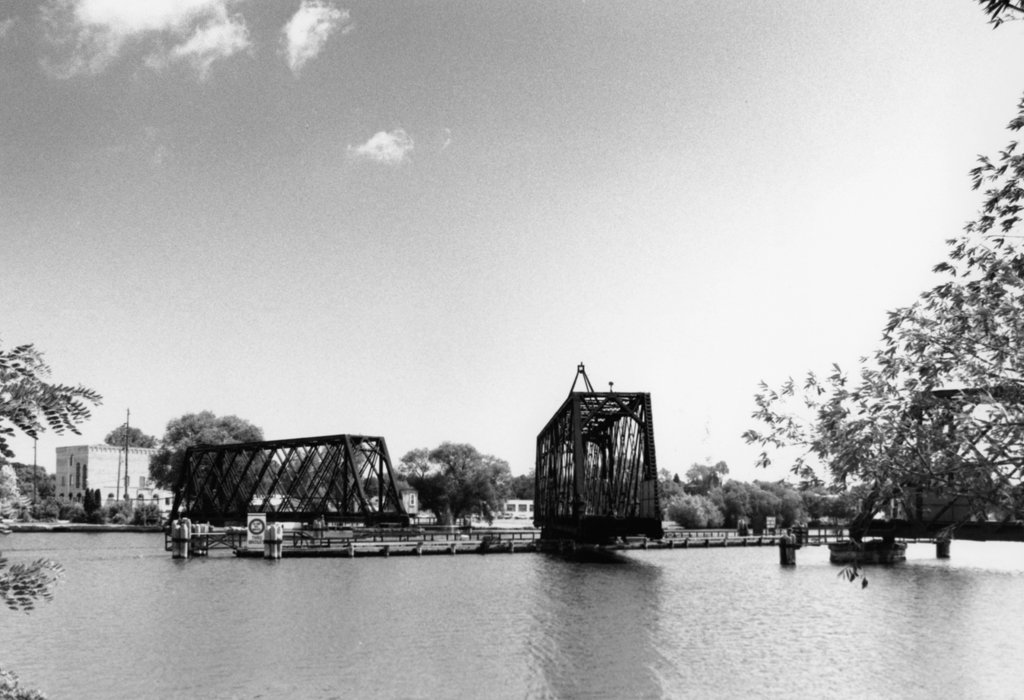
When the Chicago and North Western Railway reached Oshkosh in 1859, the company built an iron bridge to carry the tracks across the Fox River. Forty years later, this steel swing bridge replaced the original structure. The cantilevered, steel truss bridge pivots on a turntable mounted onto a pier in the middle of the river, allowing ships to pass between the river and Lake Winnebago. When the bridge is closed, a moving blade, operated by compressed air, fills the foot-wide gap in the rail connection, permitting trains to pass. Although the piers constrict the width of the channel available for ship navigation, a moving, rather than fixed, middle span allows unrestricted vertical clearance. Ironically, although the railroad built the swing bridge to accommodate water traffic, the cheaper mode of transportation that trains offered eventually diminished river shipping in this region.
Chicago and North Western Railway Swing Bridge
1899. Over Fox River near Pioneer Dr.