

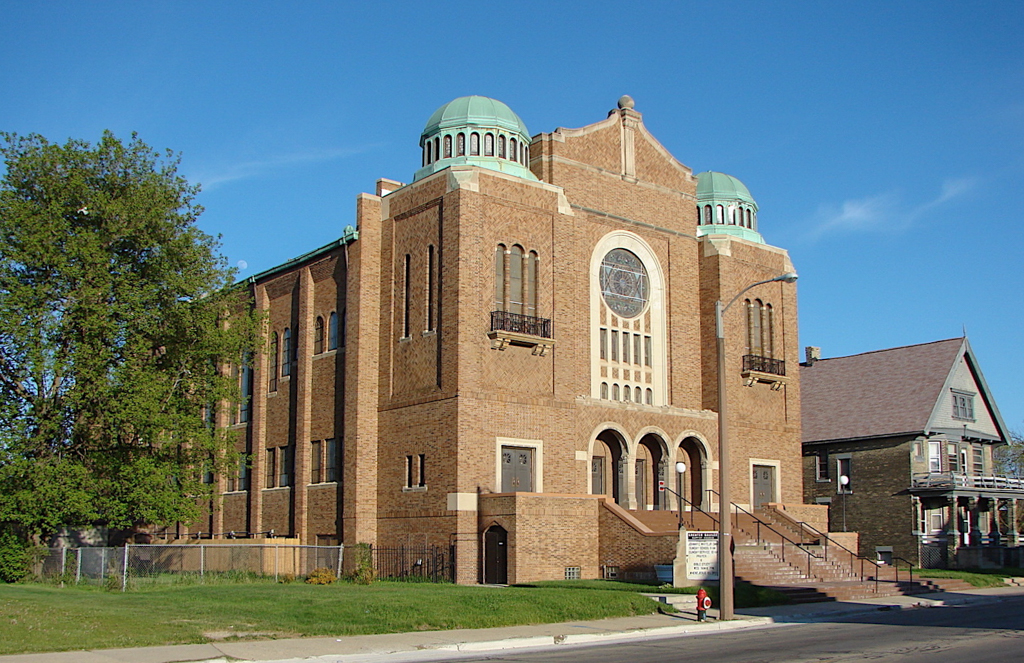
This compact rectangular building was built for an orthodox Jewish congregation. The building’s imposing form and stocky massing is embellished by low copper-domed towers, a patterned-brick facade, and a triple-arched porch. Towers pressing against the main body of the building and a large window to enhance the facade and light the women’s gallery are common in early-twentieth-century synagogues of Germany and western Poland. So is the idea of including the Star of David in the tracery of the art glass window to identify the building as Jewish. Inside, the main sanctuary rises more than two stories to a large, circular, amber glass skylight. Seating on three sides of a square connects worshippers visually, creating a sense of community.
The auditorium plan also suits many forms of Protestant worship, so as neighborhood populations changed, it was possible to convert synagogues into churches of various denominations. In this case, one of the city’s oldest and largest African American congregations, Greater Galilee Baptist Church, moved into the building in the early 1960s. Not feeling connected to the existing vaguely Middle Eastern ornament, the new occupants removed or toned down much of the stencil and plasterwork embellishment but kept the art glass and the tile and mosaic floors. To provide a baptismal font, they remodeled the focal area that formerly held the repository for Torah scrolls and constructed the font and auxiliary facilities here.