

Set into the side of a steep hill, atop a full brick basement, sits this two-story, wood-frame farmhouse. Unlike most others, it is devoid of ornament and has no formal entrance facing the road, only a utilitarian entrance in the corner of the basement story. It is plain because it was built in 1863 by the taxpayers of the Town of Springfield as the Town Poor Farm. Like most Vermont towns, Springfield originally dealt with the indigent by “warning” them out of town, but when President Andrew Jackson distributed funds from the Second Bank of the United States to all the states in 1837, Vermont chose to pass on the funds to its towns for the care of the poor. This initiated the era of the town poor farms in Vermont, where the indigent and the mentally ill worked long hours as agricultural laborers in exchange for room and board. In 1838 Springfield acquired as its poor farm what had been the tavern of Simon Stevens on the former Crown Point Military Road, but, after that structure burned in 1863, the town erected this new dwelling on its site. The building accommodated several dozen residents in small rooms on the second floor of the house, many of which remain unchanged today. Although most towns had a designated poor farm, this example is likely the only one built as such remaining in the state. About 1890 the large bank barn southwest of the house was added to increase the dairy of the farm. The poor farm operated until 1949, when it was sold and its remaining residents dispersed.
Springfield Town Poor Farm
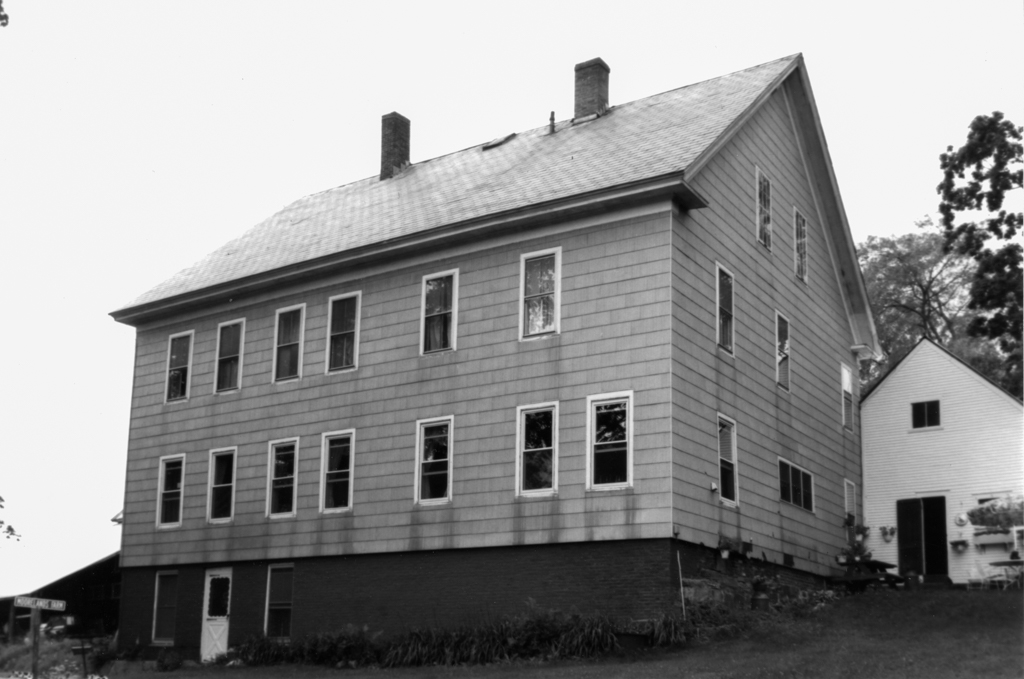 Photograph by Curtis B. Johnson, C. B. Johnson Photography
Springfield Town Poor Farm
1863. West side of Town Farm Rd., 1 mile south of Carter Rd.