

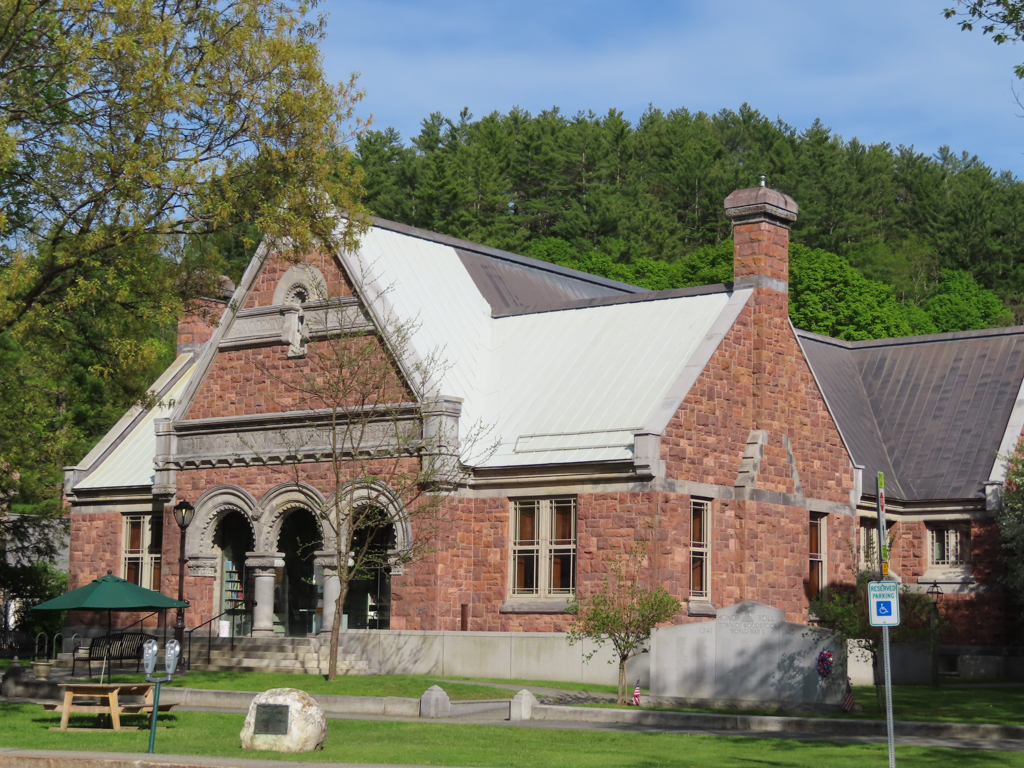
Brothers Edward and Norman Williams replaced their family home on the green with a new public library in memory of their parents, participating in an important pattern of late-nineteenth-century Vermont—native sons who achieved prominence elsewhere, benefiting their hometowns through philanthropy. Norman was a lawyer and a director of the Chicago Public Library, who in 1895 would become the first president of Chicago's John Crerar Library. Edward was a Philadelphia physician who became a successful engineer and railroad builder. For the library they commissioned Wilson Brothers of Philadelphia, who had designed Edward's house and his railroad works. Wilson Brothers suggested a building in Romanesque style, which they published in 1885 in a catalog of their work. The cruciform library has a central arcaded porch beneath a great stone gable, leading to a vestibule flanked by transept reading rooms and a navelike stack room. As executed by architect-contractor George Guernsey of Montpelier, it had Barre granite foundations, columns, and sills; Burlington redstone walls; Isle La Motte limestone water table and trim; and a Poultney slate roof (replaced by metal in 1981). The finishes were as sumptuous as the materials: cable moldings in the triple arches, metalwork executed to the architects' designs by local ferrier Oscar Farwell, carved fireplaces, polished Vermont marble walls, curved oak trusses, and stained glass windows. In 1900, Wilson Brothers expanded the building with a rear transept of the same materials and replaced the original wood shelving with steel. In 2001 the capacity was again increased, this time without altering the exterior shell, by inserting a mezzanine above the stacks and below the twenty-five-foot ceiling of the nave.
Norman Williams Public Library
1885, 1900, Wilson Brothers; George Guernsey; 2001, Mitchell Associates. 10 S. Park St., Woodstock village