

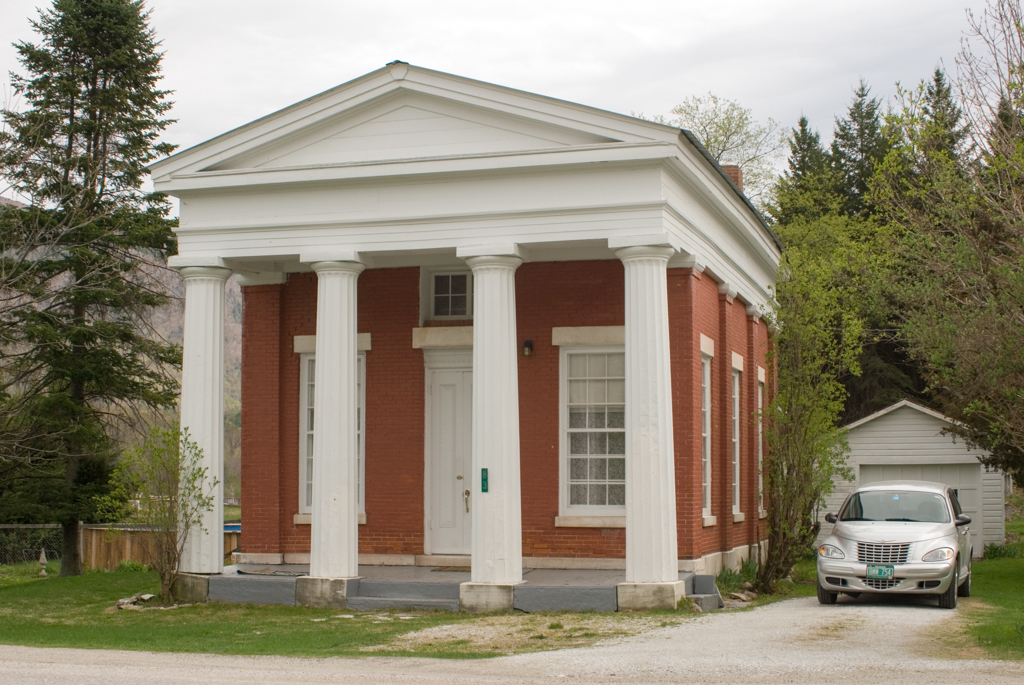
Prior to the Civil War, only a few large and midsize villages in Vermont had operating banks. Many were short-lived and few bank buildings survive, most of them in the central portion of the state. This small, wood-frame, miniature Greek temple is a later example, erected to house the Danby Bank shortly after the Western Vermont Railroad tracks and depot were built nearby in 1852. Its pedimented monumental Doric portico and overscaled entrance give the bank a classical grandeur far surpassing its size. The bank was incorporated in 1851 and failed in 1857 when the railroad went bankrupt, halting the local marble quarrying boom that shipped thirteen railcar loads of marble a day at its peak. Stylistically, the bank is very much at home in this village characterized by a variety of Greek Revival house types, a Gothic Revival church by John Cain (1838; 159 S. Main Street), and later commercial and residential building associated with the charcoal industry of Silas Griffith in neighboring Mount Tabor.
House (Danby Bank)
c. 1852. Depot St. between S. Main St. and U.S. 7, Danby village