

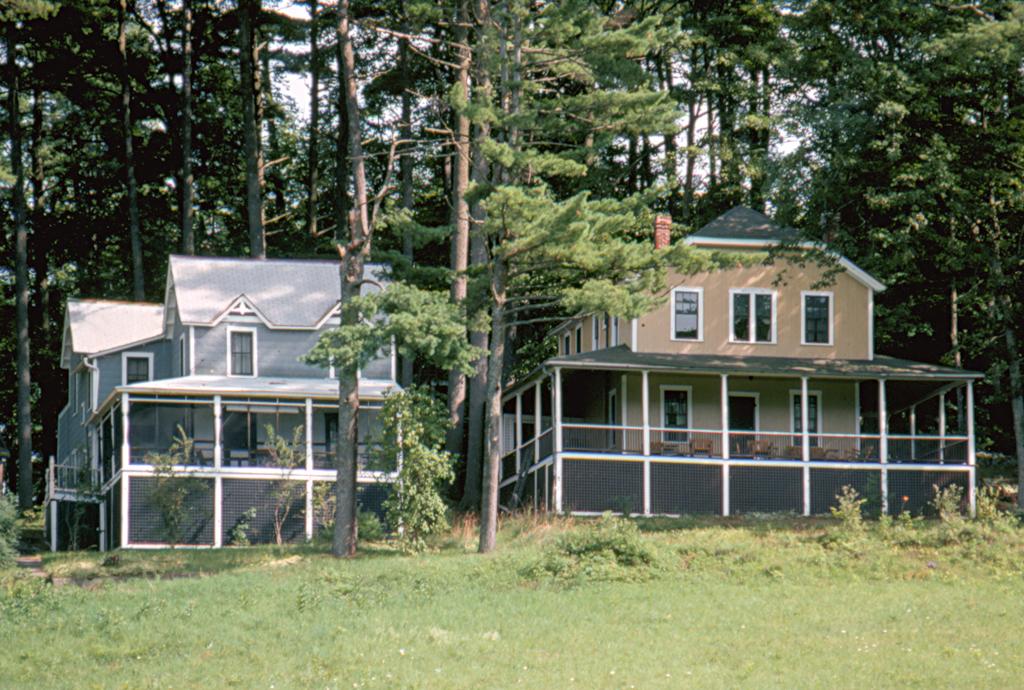
By 1900, summer colonies based on associations of family and friends populated most lake shorelines throughout Vermont. Point of Pines, a group of light, wood-frame, summer houses on thirteen acres on the west shore of Lake Bomoseen, is notable as one of the first such developments with an organized plan and shared water and recreational facilities, much like a resort. Cottage lots were arranged around three sides of a 2.5-acre common (with tennis courts), facing a shared beach and boathouse. The first lots sold in 1902, and owners erected small, one-and-a-half-story, gable-roofed camps in the vernacular popular in nearby Fair Haven, with pierced and patterned valances, bargeboards, and wraparound porches. The north side of the common developed after 1904, when the Rutland Railway and Light Company extended its electric streetcar line to Fair Haven. Rutland residents hired local contractors to build seven houses, each set into the slope with large wraparound, raised porches to catch the lake breeze. In 1907 on the north side of the common, three Rutland residents hired contractor Charles Leonard to build three two-story buildings, each with a different roof, for an average of sixteen hundred dollars each. By 1918 all of the lots were filled, and in 1924 the Point of Pines Association, along with ten houses along W. Shore Drive, was formed to maintain the common and shore facilities. Such an arrangement of cottages with recreational facilities was never the norm for summer home development in Vermont, but it was a typical starting pattern of summer camps for children.
Point of Pines
1902–c. 1925. W. Shore Dr., 1.1 miles north of VT 4A, Lake Bomoseen