

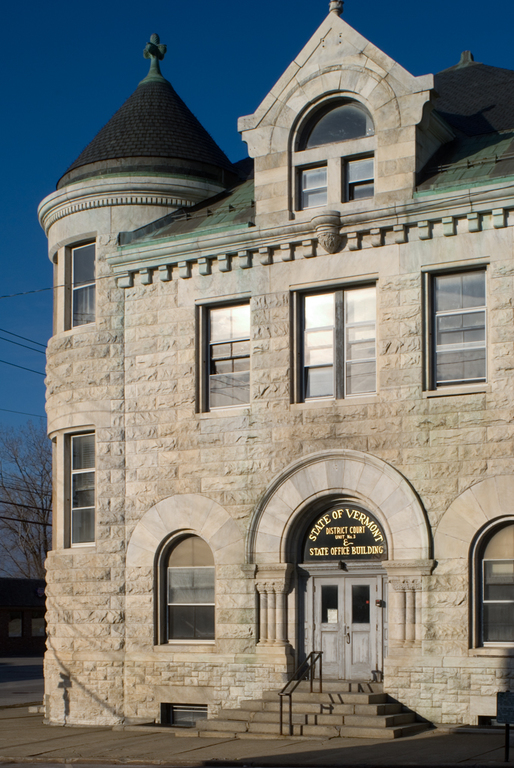
The stony massiveness of this building reflects the still-prevailing Romanesque taste of the supervising architect's office in the early 1890s, and its fortresslike mien seems appropriate for the home of one of the nation's busier custom houses. A significant port of entry (and smuggling) since its earliest days, St. Albans became a center of international commerce with the completion of rail links to Montreal. Thus, the custom office's location before this new facility was built was on the ground floor of the railroad administration building. The importance of the custom house is indicated by its cost, $110,000 as compared with $35,000 for St. Albans's contemporary city hall. It may have been designed during the tenure of Supervising Architect W. J. Edbrooke, since it bears strong similarities to features of his contemporary post office in Washington, D.C. Here, the blocky mass of rock-faced marble is enlivened by conically capped towers, arched entrances carried on clustered colonnettes, and fine decorative carving. Nearly complete at the time of the great fire of 1895, the shell survived, though the interiors had to be refinished. By 1905 this custom office ranked among the top 20 percent in the nation in receipts. In the 1920s a monthly average of 5,000 bottles of liquor were confiscated at the border crossings in its charge. Violations reported in 1928 included the seizure of 190 cars and more than 100,000 bottles of “spirituous beverages,” valued at $250,000. In 1937, the government's Works Progress Administration (WPA) recognized the activity of this office with a larger, WPA-built Colonial Revival Post Office and U.S. Custom House on S. Main Street. The building on Kingman Street was adapted for other federal, and now state, purposes.
State Office Building and District Court (U.S. Custom House and Post Office)
1896, Office of the Supervising Architect of the U.S. Treasury. Kingman St. a Federal St., City of St. Albans