

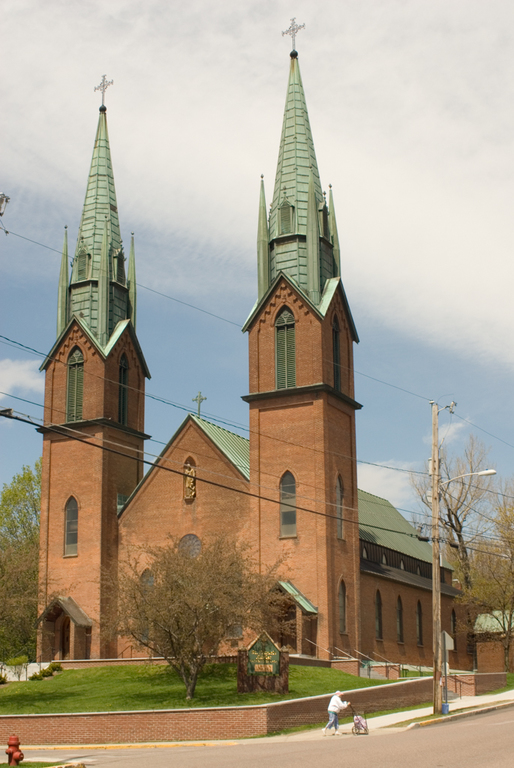
A church with strong Quebecois connections, St. Francis Xavier was built for the French Canadian Catholic community drawn to Winooski by the post–Civil War textile boom. By 1868 the immigrants had so overwhelmed Burlington's first French parish that Bishop de Goesbriand called Father Jean Audet from Quebec to establish a congregation in Winooski. Although Patrick C. Keely was responsible for much of the Anglophone construction in the diocese, the bishop turned to the Reverend Joseph Michaud, a priest and architect of Montreal, for the design of St. Francis. Michaud, who was responsible for some four hundred churches and religious buildings in the Montreal-Trois Rivières region, created a simple but imposing landmark for Winooski. Set commandingly on a hillside overlooking the city, the brick Gothic Revival basilica presents a spare but striking facade flanked by towers with tall octagonal spires. Silhouette and proportion are important. Given the budgetary restrictions of a workers' parish, decoration is minimal: the three pointed-arched doors (covered since 1964 by gabled porches) and the lancet windows and belfries have brick drip moldings, the tall first stages of the towers have recessed panels, and the cross-gabled second stages have stepped corbels. A small wheel window and a central niche that contains the statue of St. Francis are typical of French Canadian tradition. In the initial construction campaign the towers finished at the cornice of the first stage, corresponding with the peak of the nave roof. The second stage and octagonal spires with corner finials were completed in 1882. The result was a cross between the Romanesque Paderborn Cathedral in Germany and the Abbaye-aux-Hommes in Caen, France. The metal cladding of the towers and the wrought-iron crosses that crown them are the work of tinsmith Joseph Lanou of Burlington.
St. Francis Xavier Church
1870, 1882, Joseph Michaud. 3 St. Peter St., City of Winooski