

Being so involved in solutions to mechanical problems, Pittsburgh also took an early lead in American aviation: the first transcontinental plane was built here in 1910. As early as 1915, amateur pilots were taking off from the old racetrack in Schenley Park, and Pittsburgh
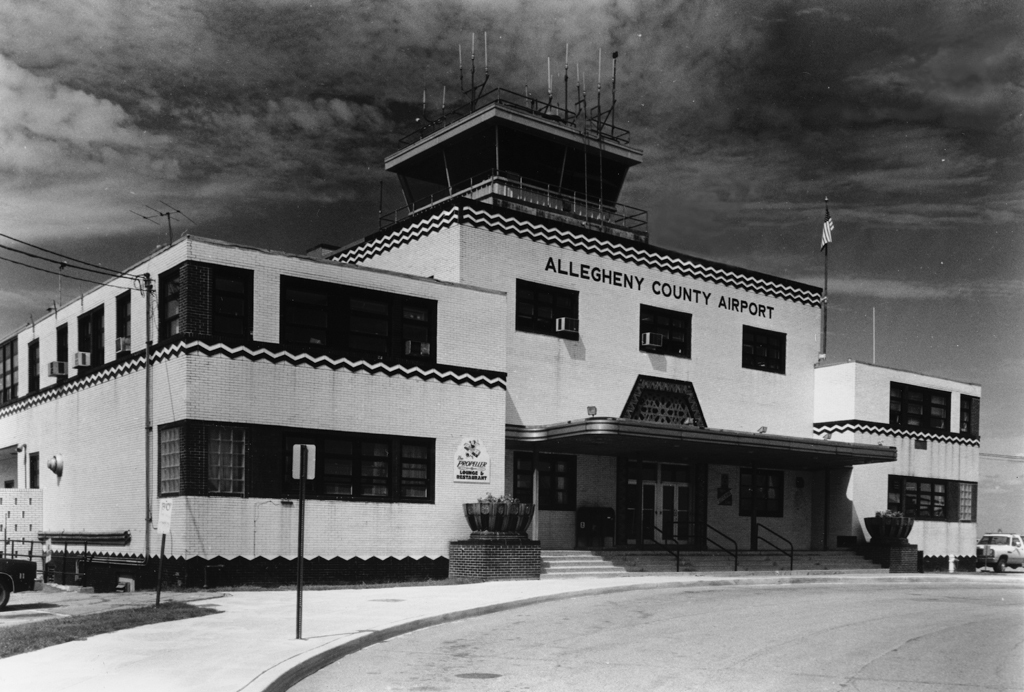
Architecturally, the airport marks a cautious essay in modernism by two Beaux-Arts designers who made clear where their real design loyalties lay. Published sketches for the airport show that Stanley Roush, Allegheny County architect, was first thinking of something considerably more streamlined, akin to Erich Mendelsohn's widely published department stores of the 1920s in Germany. In the end, a more comfortable Art Deco triumphed. The airport makes no secret of its affinity for the Beaux-Arts, however. Architectural historian James D. Van Trump has likened it to a small Baroque country palace, with its horticultural allees turned into a starburst of runways.
The exterior's Art Deco, nationally popular in the 1920s and 1930s for transportation terminals of all types, has Mayan-style zigzag friezes in rich earth tones in a field of glazed white bricks that tie the building to the land and the sky. Roush's vivid green and black terra-cotta pots at the entranceway also represent the earth's clay, though the decoration on them represents banks of stylized planes. The building's taller central section, surmounted by the control tower, is symmetrically flanked by lower wings. Henry Hornbostel oversaw the design of their second stories and a one-story addition at the rear. The airport survives today as a notable instance of an Art Deco building almost unchanged physically or programmatically. Still busy, it is now restricted to corporate jets and private planes.