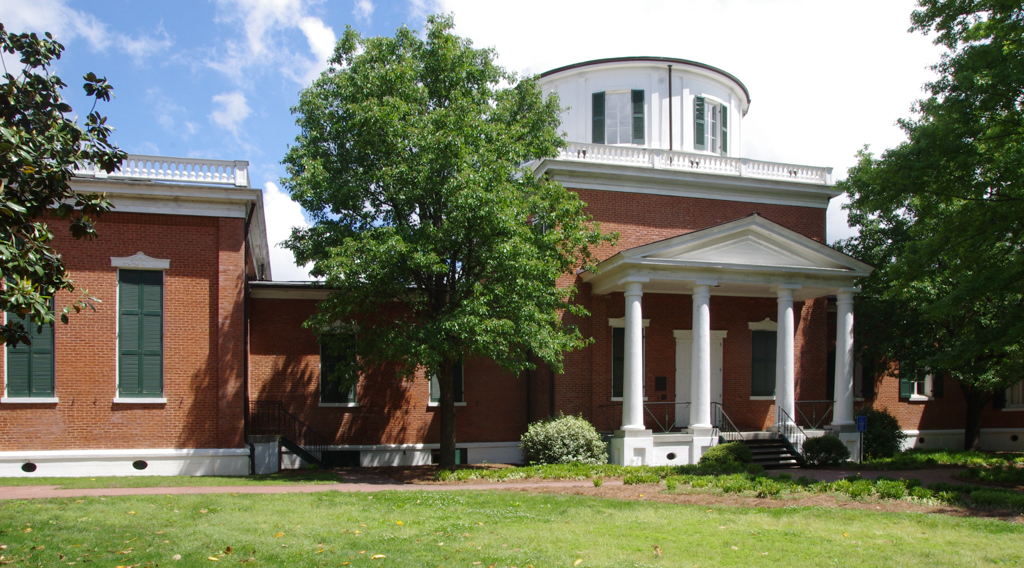
Located north of The Grove, a wooded area on the University of Mississippi campus, the Barnard Observatory building now houses the Center for the Study of Southern Culture, but its origins were scientific and audacious. When Frederick A. P. Barnard became chancellor, he set out to make the university a national leader in what was then called "experimental science" by abandoning the classical method of recitation in favor of observation and experimentation. To further his plan he commissioned a structure housing telescopes and laboratory equipment for physics, using as his model the observatory at Harvard College (c. 1846), a building composed on a five-part Palladian plan, with central block, connectors, and terminating flankers. For Barnard, this meant a cubic, brick, central mass with a portico, minimal openings, and a wooden drum awaiting the telescope, which was to be larger than Harvard's but never arrived because of the Civil War. Atop the flankers, roof monitors were to receive a smaller telescope and a comet seeker, more dreams left unfulfilled. Barnard departed for what is now Columbia University in 1864 and with him went the cause of advanced science. The equipment for physics experiments, which did arrive, is on display in the University of Mississippi Museum.

