

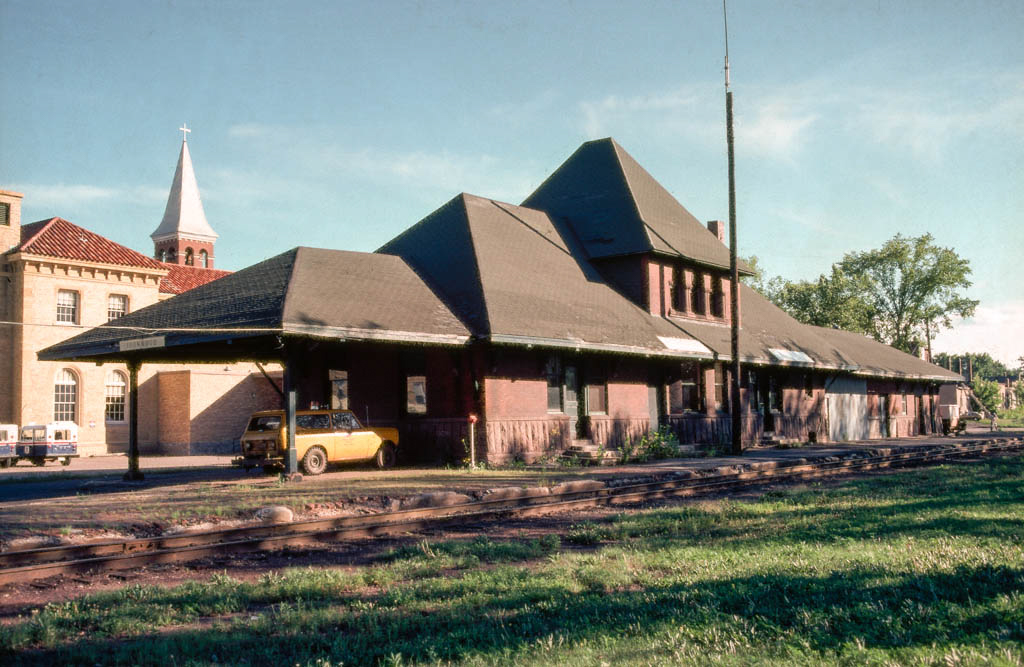
This red sandstone and brick building, with its hovering hipped roofs and round-arched openings, is a provincial reflection of the railroad stations of H. H. Richardson. It served as the passenger depot for the Milwaukee, Lake Shore and Western, later the Chicago and North Western Railroad, the line that connected the mines of the Gogebic Range with the ore docks on Lake Superior at Ashland, Wisconsin, and aided in the development of Ironwood and the Gogebic Iron Range. Joe Piersen of the Chicago and North Western Historical Society Archives attributes the design of the depot to Frost, well-known for designing railway stations for the Chicago and North Western. In fact, Frost did both the Union Passenger Station of the Wisconsin Central Railroad (1889) in Ashland, Wisconsin, and, with Alfred Hoyt Granger, the monumental Chicago and North Western Passenger Terminal (1905–1911) in Chicago. Educated at the Massachusetts Institute of Technology, Frost worked with Peabody and Stearns in Boston, and later, with Henry Ives Cobbs in Chicago. The station's strongly developed and broad roof exemplifies Frost's acknowledgment that the depot is intended for people who need shelter while waiting. The Ironwood depot physically separates the south commercial district from the north residential area. During the railroad's most active years, twelve trains stopped here daily. To the southeast at 100 E. Ayer Street is the Lombard-styled U.S. Post Office (1931, James A. Wetmore).
Ironwood Area Historical Museum (Ironwood Station of Chicago and North Western Railroad)
1892, attributed to Charles Sumner Frost. 150 N. Lowell St.