

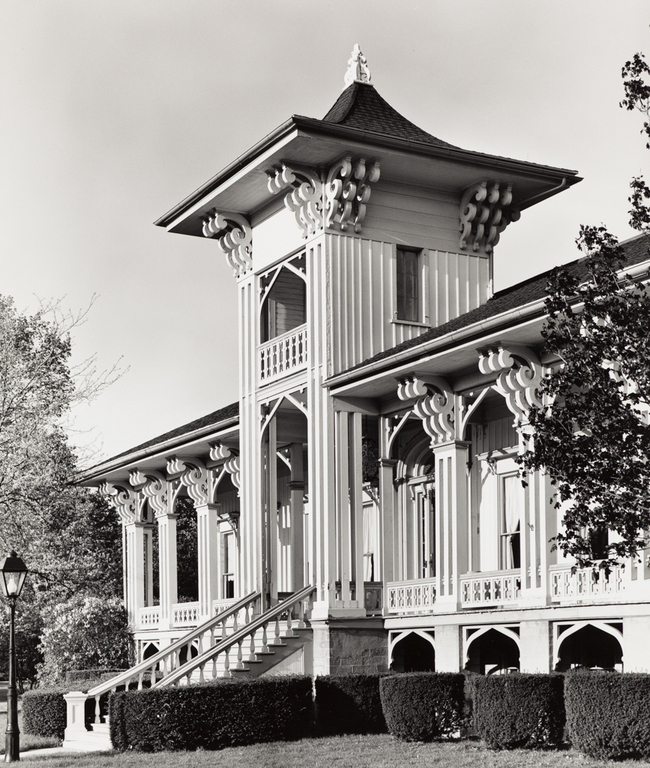
Based on Hawaiian prototypes, with Italianate stylistic elements, the fanciful Honolulu House is Marshall's most famous building. The board-and-batten house rests on a five-foot-high Marshall sandstone foundation and has an almost pagoda-roofed central tower. A veranda, with an ornamental railing, triple supports with large triple convoluted brackets projecting from the pier capitals to the eaves, and wooden ogee arches, runs the length of the building. Inside the house, a wide staircase sweeps upward from the main hall to the observation deck in the tower. Large parlors with fifteen-foot-high ceilings open off the hall. The walls were covered with paintings by itinerant artist F. A. Grace, depicting tropical vegetation. Abner Pratt (1804–1866) served as the U.S. consul to the Sandwich (Hawaiian) Islands in 1857–1859. On returning to Marshall because of the poor health of his wife, Eliza, he built this exotic residence and filled it with tropical decoration, as a remembrance of his consular service. Restoration in 1984–1986 included decorative interior painting funded by a Michigan Department of Transportation Heritage Route grant and the Marshall Historical Society. The house currently serves as headquarters of the Marshall Historical Society.
Honolulu House (Abner and Eliza Pratt House)
 Balthazar Korab
Honolulu House (Abner and Eliza Pratt House)
c. 1860, attributed to William L. Buck. 107 N. Kalamazoo St.