

The earliest of the twenty-five public housing projects constructed in Boston between 1938 and 1954, Old Colony Village retains many of the virtues boasted by early housing activists, with low-rise buildings and treed courtyards supposedly bringing suburban advantages to low-income city dwellers. The result of a long contentious period of development, Old Harbor Village was originally intended as a slum clearance project for nearby land. When public outcry over the use of eminent domain and the fair price for the real estate stalled the initial project, it was moved to this vacant site. The complex provides 1,106 apartments, mostly in three- or four-story brick buildings, relieved by limestone band courses between the first two levels and by balconies ornamented with crossed anchors and stars. Farther from the exterior roads, 152 row houses were designed to evoke a New England coastal village, with differentiated doorways and porches fronting landscaped quadrangles or streets. These units initially provided highquality housing to a group of politically well-connected, nearly poor South Bostonians. In 1961, the city council renamed the project to honor the mother of Congressman John W. McCormack, Speaker of the House of Representatives and a South Boston native. The original clearance site became the Old Colony Housing Development (265 E. 9th Street), designed by Henry and Richards in 1940 in a more Spartan manner—three-story brick, flat-roofed boxes (relieved now by mature street trees)—characteristic of Boston Housing Authority complexes of its generation.
Mary Ellen McCormack Development (Old Harbor Village)
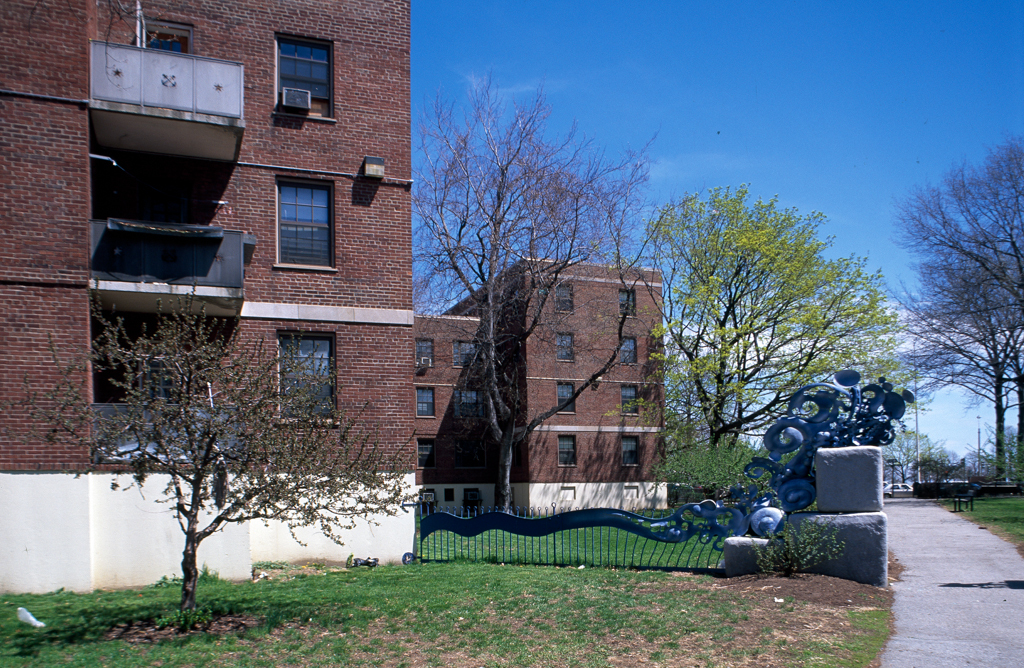 Peter Vanderwarker or Antonina Smith
Mary Ellen McCormack Development (Old Harbor Village)
1938, The Seventeen Associated Architects. 354 Old Colony Ave.