

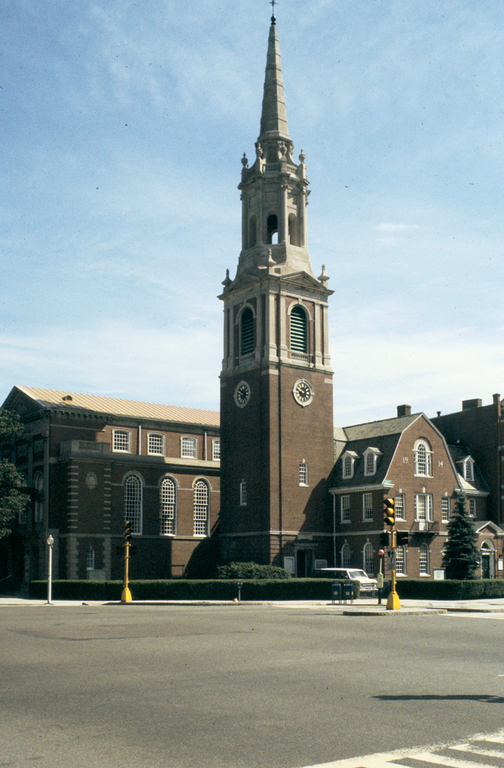
As originally envisioned by Frederick Law Olmsted in 1886, Audubon Circle was to be outlined with trees, which would continue up the center of Beacon Street. While Brookline planted its Beacon Street trees, Boston (where Audubon Circle is located), did not. The most prominent landmark on Audubon Circle is the Ruggles Street Baptist Church, erected as the Second Church in Boston (Unitarian). Known for their Gothic Revival–style Episcopal churches, Cram and Ferguson designed a Georgian Revival–style church for this post-Reformation denomination. Facing Park Drive, the nave of the church projects a richly detailed facade ornamented with pilasters supporting a pediment. Perpendicular to the nave with an entrance on Beacon Street extends
Ruggles Street Baptist Church
 Keith Morgan
Ruggles Street Baptist Church
1913–1914, Cram and Ferguson. 874–880 Beacon St.