

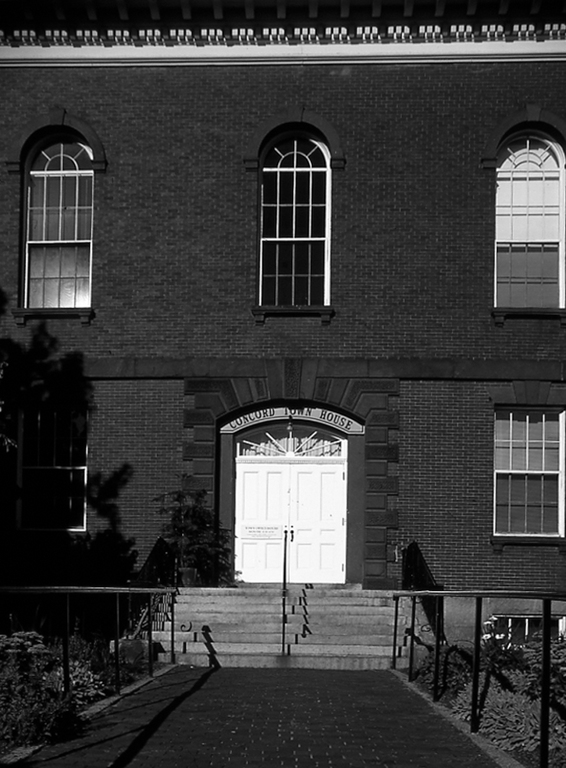
Monument Square is the historical, political, and institutional core of Concord. About a year after the 1635 incorporation of the town, under an oak tree at the northwest intersection of Monument Square and Main Street, the Reverend Peter Bulkeley and Major Simon Willard sealed the purchase of a six-mile-square plantation from local Indians. Monument Square, the northern half of the original common, became the center of political life in Concord. Named a “shire town” of Middlesex County by at least 1692, Concord built a combined courthouse and town house in 1721. That building and its replacement, which burned in 1849, were superseded by another Middlesex County Courthouse (1851, with multiple additions to the rear in the mid-twentieth century, NRD), at 30 Monument Square, a handsome Italianate clapboard building. Because the county ceased to permit the town to hold town meetings in the new courthouse, Concord had to build a new Town Hall (NRD), at 22 Monument Square, also in 1851. Architect Richard Bond, who had remodeled First Parish Church in 1841, designed the brick and brownstone Italian-ate town hall, which continues as the seat of town government. It provides the area's best surviving work by Richard Bond, whose similar Lawrence Hall (1847) and Gothic Revival Gore Hall (1838–1841), both for Harvard University, have been demolished. Across Bedford Street from the town hall stands St. Bernard's Roman Catholic Church (NRD) at 12 Monument Square, originally the home of the Universalist church when built in 1840–1842 facing Bedford Street. The Catholic Archdiocese of Boston purchased the building in 1863 for the fledgling congregation of Concord
Monument Square
 Peter Vanderwarker or Antonina Smith
Monument Square (Concord Town Hall)
1820–1889. Monument Sq.