Bedford Center Historic District

Bedford Center Historic District

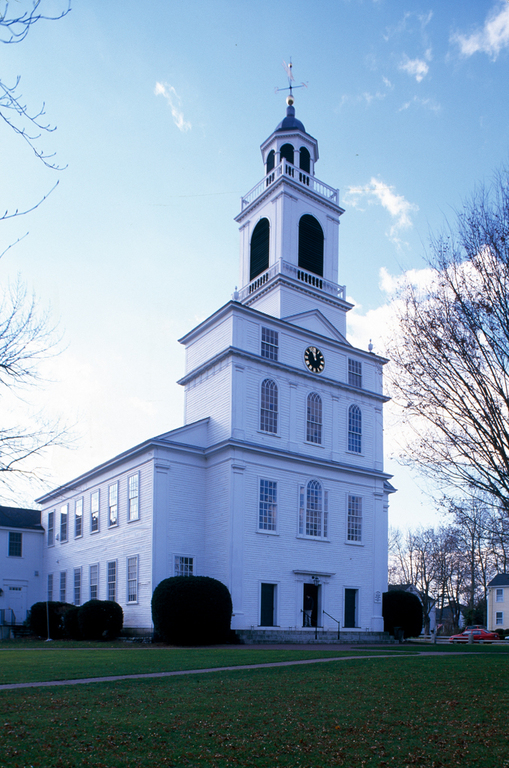
First Church Peter Vanderwarker or Antonina Smith

First Church

The Great Road.

The historic center of Bedford records clearly the colonial and early-nineteenth-century character of the community. Bedford was established in 1729, the year that the first meetinghouse was raised on Bedford Common. The current First Parish Church (1816), at 25 Great Road and constructed by local carpenters Joshua Page and Levi Wilson to the designs of Samuel Blodgett, replaced that building. The architect was evidently influenced by the work of Asher Benjamin, whose 1813 book included a design for a “Congregational meeting house at West Boston,” which is strikingly similar to the Bedford church. At the time of incorporation, three buildings stood in the town center, one of which survives. The Fitch Tavern (1710) at 12 Great Road was built as a clap-boarded five-bay center-chimney farmhouse and later converted to a tavern from which the men of Bedford marched forth to confront the British at Concord in April 1775. The Domine Manse (1730), a substantial five-bay clap-boarded house with projecting pedimented porch at 110 Great Road, was built to settle the first minister, Nicholas Bowes, and was subsequently the home of the first schoolmaster. When theological problems forced the Trinitarian Congregational Society to separate from the First Church, Unitarian, the group built their new church (1832) at 25 Great Road, showing pretensions to contemporary architectural ideals in the Gothic detailing of the elaborate entrance. Italianate ornament on the end-gable Town Hall (1856) at 16 South Road also demonstrates new stylistic influences. Along the Great Road and the intersecting streets, one still finds a community of nearly one hundred eighteenth- and early-nineteenth-century buildings that nobly project the early character of the town.

Writing Credits