

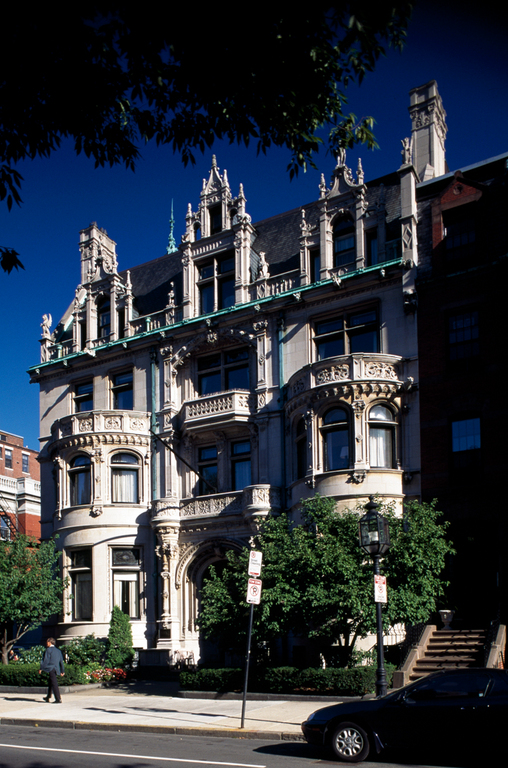
A peacock among sparrows, the Albert Burrage House is the sole incursion of Fifth Avenue flamboyance into the Back Bay. It is significant chiefly as an illustration of what Commonwealth Avenue might have been but for the self-imposed restraint that animated most Back Bay architects and clients. Bristling with turrets, bay windows, gargoyles, crockets, and putti, the exterior is indebted to the sixteenth-century chateaux of the Loire valley, particularly Chenonceaux, as well as such New York reflections as R. M. Hunt's William K. Vanderbilt house of 1882. If the overall effect is one of grandiosity rather than true grandeur, it is redeemed from mere ostentation by the quality of its materials and workmanship, and its relationship to the context improved by the general symmetry of its elevations.
Albert Burrage House
 Peter Vanderwarker or Antonina Smith
Albert Burrage House
1899, Charles Brigham. 314 Commonwealth Ave.