

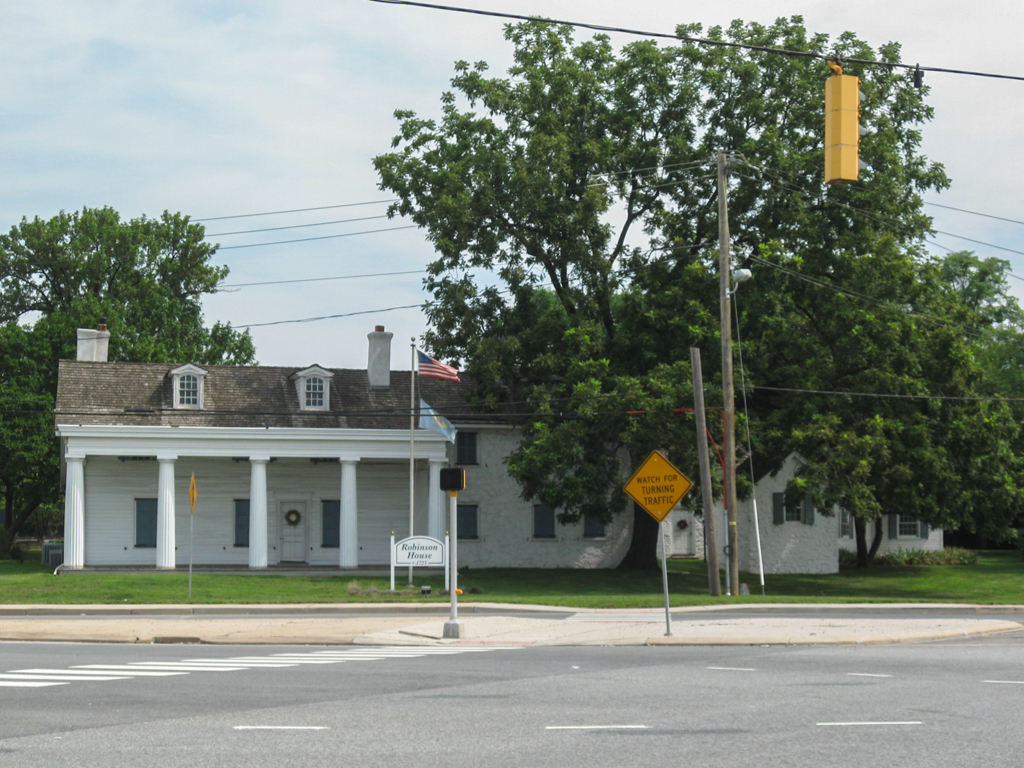
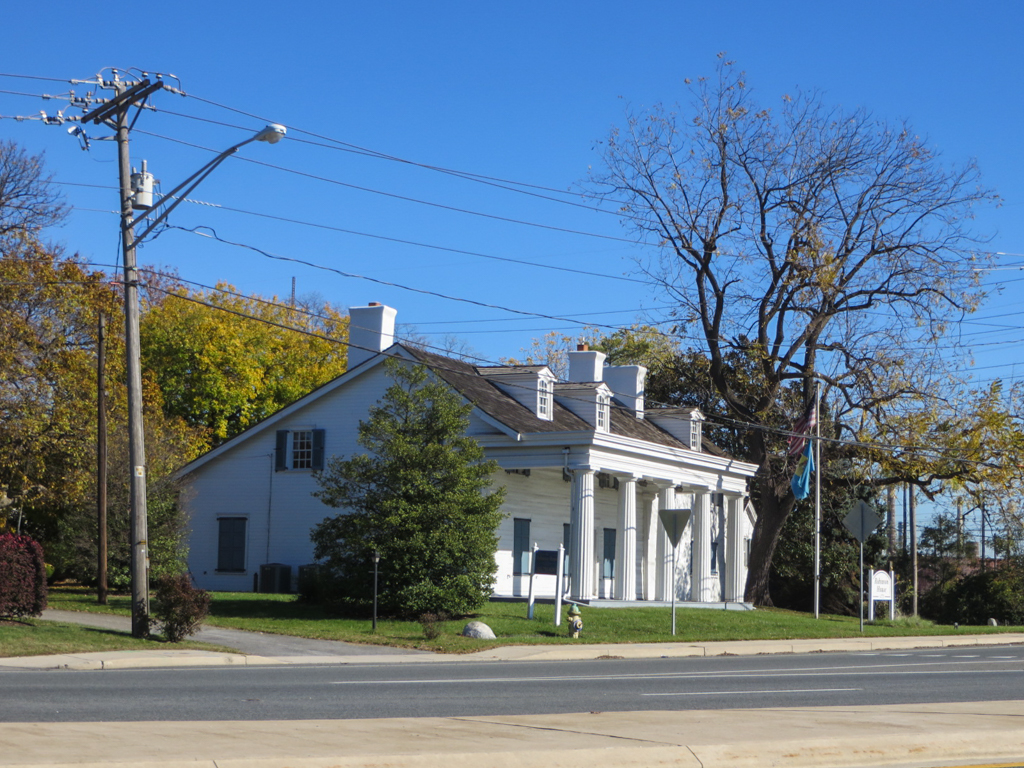
Thomas Robinson and his descendants owned this inn on King's Highway (now Philadelphia Pike) from 1745 to 1851. Recent investigation showed that its first section is plank-framed, possibly the only example surviving in the Delaware Valley. It has been plausibly argued that Washington stopped here in 1777 when his army camped nearby. A photograph c. 1905 shows the dilapidated house with a portico of slender columns. Students of artist Howard Pyle used it as a studio until its conversion into a popular tea house restaurant in 1914, which operated for fifty years. A five-column Doric portico was added, giving a Greek Revival effect. In 1966, it seemed that the site would be cleared for a motel. State archives director Leon deValinger was mostly interested in the square stone “Blockhouse” at the rear of the site, believed to have been erected in 1654 to protect the sawmill of Swedish settler Johan Rising. Swedes often fortified industrial operations, and slitlike openings suggested embrasures for warfare against Indians. De-Valinger thought the Blockhouse might be the oldest surviving building in Delaware, and plans were made to transport it to Fort Christina (WL2). Fortunately, the state archives purchased the entire property in 1967, averting any demolitions. Archaeology later showed, disappointingly, that the Blockhouse was built in the eighteenth century, probably as a kitchen. The Robinson House was restored for the 1976 Bicentennial by architect Robert Raley, and the Claymont Historical Society has made plans to convert it into a museum.
Robinson House (Naamans Tea House)
By 1728 main block. c. 1750 west addition. c. 1790 stone section at east. c. 1914 Doric portico. 1750–1790 “Blockhouse.” Philadelphia Pike (U.S. 13) and Naamans Rd.