

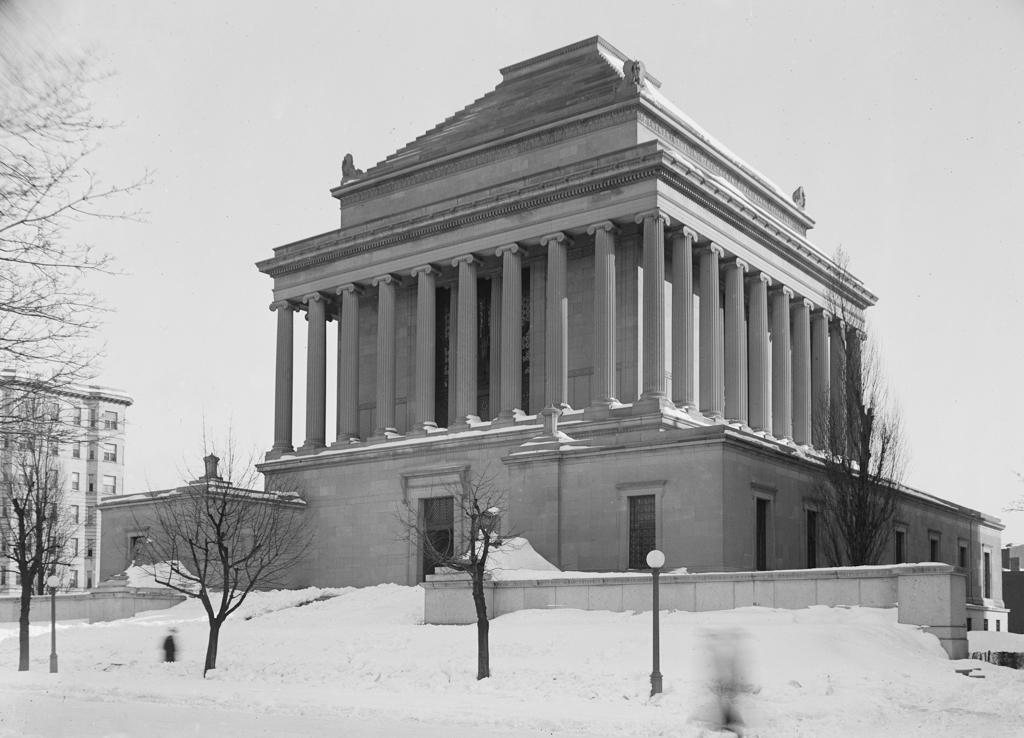
The local Scottish Rite Masonic Temple that serves Supreme Council 33 (distinct from the national function of MH12) is a good example of the application of modernized historical decoration to a modernist formal vocabulary. Raised on a terrace 5 feet above and set back from the sidewalk, the temple is purposefully remote and self-contained as befits a building serving an organization with limited membership and secret ceremonies. Monolithic in massing, it is composed of two intersecting volumes, a 70-foot cube that rises above and projects slightly in front of a rectangle that extends back 129 feet. It is difficult to conceive that this shell contains 81 rooms; it was erected at a cost of $350,000. Front facade surfaces are unbroken by windows or moldings of any kind, with the exception of the magnificent overscaled entry portal set in a massive rectangular arch and consisting of a forbidding handleless bronze door set beneath John Joseph Earley's striking concrete and stone mosaic. The architects reinforced the geometry of each individual mass of the temple by using limestone slabs of the appropriate shape for each section: square ones on the cube, rectangular ones set horizontally for the recessive rectangle, and rectangular ones set vertically in the arch. Earley's mosaic of pulsating rays of color is autumnal in hue, focused on a bronze eagle, and framed by a filigreed bronze screen of animals of symbolic importance to masonic rites. Massive mosaic amphorae decorated by Earley flank the entrance arch; his technique of outlining each decorative motif's color change with incised lines can be readily seen.
Scottish Rite Temple
1938–1939, Porter, Lockie and Chatelain. 2800 16th St. NW