

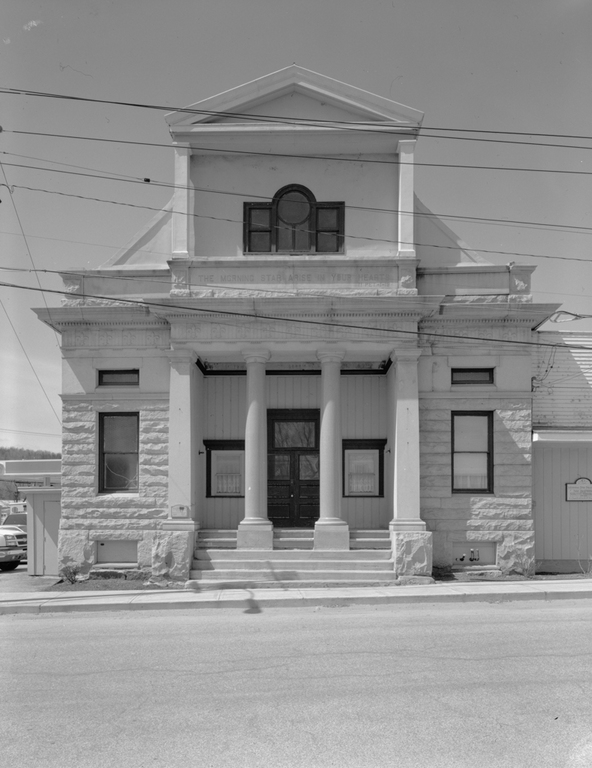
The Italian Baptist Church was built to designs by its first minister, Bellondi, who was inspired by the buildings of his native Italy. While the basic form of the church's monumental facade, with polished granite columns in antis, a full Doric entablature, and a pedimented parapet with a Palladian window and scrolled wings, was partially inspired by Leon Battista Alberti, many details are from the early twentieth century. Walls are made of local granite tooled by modern methods, windows are stock two-over-two sashes, and pressed metal lines the walls, pediment, and ceiling of the entrance.
Built with skilled, volunteer Italian immigrant labor, the church was founded by the Baptist Association of Vermont in an effort to offer evangelical doctrine in the middle of Barre's close-knit Italian Catholic neighborhood. Inspired by Bellondi's enthusiasm, the congregation grew through World War I, but dwindled thereafter. The building passed to the Order of the Redmen and the women's Degree of Pocahontas c. 1935, the Seventh Day Adventists in the 1950s, and in 1966 to the Church of Prophecy. During each of these changes in ownership some of the building's original details were lost. Nevertheless, with its evocation of high-style design using local materials and know-how, the structure is one of Vermont's most distinctive vernacular monuments. It is also another example of the inventiveness and craftsmanship of Barre's Italian Americans.